
Discussing the problem of indecent material on the internet is not enough; there is a need for strict measures at technical and legal levels. Fundamental changes in the system are necessary to curb the arbitrary behavior of criminals and technology companies.
19.1 Using the Law as a Whip to Remind of Human Values
Stopping the spread of indecent material is no longer the work of one person or one family; it is a collective battle. In this battle, technology and law are the two most effective weapons. Until now, we have viewed this problem only from a moral perspective, but now changes in the technical system itself are necessary that can stop obscenity at its root. Raising the whip of law to remind tech companies of human values over their profits has become essential.
Merely having regulations will not suffice to make the digital world safe; a technical machinery that strictly implements those regulations must be established. Changes at the system level can significantly reduce the impact of this problem. These solutions are not just to stop criminals but to make the use of digital media more responsible.
19.2 Concrete Steps at the System Level
To stop indecent material, the first step is to make changes in the fundamental system of the internet. This includes making ‘Internet Service Providers’ (ISPs) and search engines more responsible. When a user attempts to search for indecent material, search engines should automatically give warning notices or stop showing results for such websites. The ‘blocklisting’ process at the system level should become faster and automated.
Additionally, ‘parental control’ features in browsers should not remain optional but be default. Firewalls should be erected at the technical level that recognize and block indecent data packets. Merely banning websites will not suffice; servers from which this material is broadcast need to be technically isolated. When the technical system itself starts refusing obscenity, only then can the economic backbone of this business be broken. These changes are possible through technical cooperation at the global level.
It will happen at the global level when it does. But we can at least start using indigenous platforms like Aatoplay, Apnatube, Artai, Neighbors, Kutumb, Inbook, Koo, etc., in place of such social media. I have accounts on each of these places. Soon, a movement to boycott foreign social media will be started through these indigenous media. Then come here and support the foreign social media boycott movement. Nothing will happen with me alone, but if we all start doing it together, many things will change.
19.3 Age Verification: Is Implementing Strict Entry Controls on Platforms a Solution?
Currently, accessing indecent websites requires only clicking a button saying ‘I am 18 years old’. This is extremely weak entry control. Instead, strict ‘age verification’ systems should be made mandatory on such platforms. Access should be granted only after using official identity documents or biometric information of the user. This solution is often suggested. But this is not a solution at all. Destroying such indecent material is the only solution. If documents are required to be provided for age or identity verification, personal information will be given to these foreign companies. And creating fake identity documents is easy in this country. So this solution is completely useless. On the contrary, this solution will start the misuse of personal information.
Not only indecent websites but social media platforms should also have restrictions on certain search results for children below a specific age. Companies can use ‘face recognition’ technology to estimate the user’s age and show content accordingly. Some countries in Europe have taken steps in this direction. Until entry controls are strict, children will continue to come into contact with this danger. Technical work is needed on how this verification can be done without breaching privacy. This is also a half-measure. And there are risks of personal information misuse in this too. My point is only one: why should such indecent material exist on the internet at all? The adverse effects of this material have been mentioned earlier, which are harmful for children, adolescents, adults, and the elderly alike.
19.4 Pre-Upload Filtering: Using AI to Stop Content Before It Spreads
Once indecent material reaches the internet, it spreads like wildfire. Therefore, ‘pre-upload filtering’ can be an extremely effective solution. In this, artificial intelligence (AI) will be used to check any video or photo before it is uploaded to the platform. If obscenity, child sexual exploitation, or non-consensual visuals are found in that content, it will be blocked at that very moment. This is an excellent solution. Just as videos are checked for copyright after upload on YouTube, the same can be done for indecent depictions. Therefore, work should be done on this solution and implemented as soon as possible. So that there will be no place for such material.
This technology will stop criminals from getting a platform. Large tech companies already have ‘hash matching’ technology, which can prevent previously banned videos from being re-uploaded. By advancing this system, suspicious content can be sent for human review. If companies mandatorily implement this technology, 90 percent of obscene material can be destroyed before reaching people.
19.5 Ending Anonymity: Debate on Verified Social Media Accounts
A large part of obscenity and harassment on the internet is due to the facility of ‘anonymity’. Criminals open accounts with fake names and spread indecent material. If ‘verification’ based on identity proof or other official documents is made mandatory for social media accounts, fear will be created among criminals. When a person’s digital identity is linked to their real identity, they will not dare to commit indecent acts.[1] But again, there is the same risk of personal information misuse.
There is a major debate on this regarding privacy issues, but considering safety, this seems a necessary step. At the very least, this verification process should be mandatory for content creators or those with many followers. Once the veil of anonymity is lifted, it will become easier for police to trace cyber criminals. Holding a person accountable for their digital behavior is the only way for responsible internet use.
19.6 Holding Company Executives Accountable: Piercing the Corporate Veil
Often, tech companies shift the responsibility for crimes solely onto users and free themselves.[2] To stop this, it is necessary to hold company senior executives (Compliance Officers) personally accountable. If laws are repeatedly broken on a platform, provisions should be made in the law to file criminal cases against the company’s top officials. This is called ‘piercing the corporate veil’.
When company executives realize that they may face imprisonment due to the company’s wrong policies, only then will those companies strictly implement safety rules. Along with this, until very heavy financial penalties are imposed for this delaying behavior of companies, companies will not change their policies. No matter how much money there is, it ends someday, and for business companies, their money and profit are more important. Therefore, by imposing heavy financial penalties and declaring company executives criminals to fix personal responsibility, those companies will work at war level to control indecent content. This legal step will put a major curb on the arbitrary behavior of tech companies.
19.7 Data Localization: Forcing Platforms to Store Data in India
The biggest obstacle in investigating cyber crimes in Bharat is data being abroad.[3] For this, ‘data localization’ is an extremely important legal solution. Every tech company providing services in Bharat should be mandated to store Bharatiyas’ data on servers within Bharat’s geographical boundaries. This will allow Bharatiya investigation agencies to obtain information immediately without getting stuck in any international legal process.
If data is in India, police can obtain IP addresses, chat logs, and other evidence within hours, which currently takes months. This solution will make it easier to catch criminals blackmailing Bharatiyas or running obscene rackets while sitting abroad. Data localization is not just a technical issue but a question of national security for digital sovereignty and citizen safety. This decision will make it possible to protect Bharatiya society from the global web of obscenity.
If these solutions are implemented, we can extricate society from the grip of obscenity on the internet. In this matter, the Bharatiya government has now implemented the Digital Personal Data Protection Act, 2023 (DPDP Act 2023) in the country. This is an important decision taken by the Bharatiya government in all these matters. Along with this, we should support our indigenous apps. Once again, an indigenous movement is necessary for this country.
19.8 Legal Provisions:
Police complaints can be filed against those posting such content under the following sections. For filing such complaints, you can seek appropriate legal guidance –
Bharatiya Nyaya Sanhita, 2023 – Sections 49, 79, 294, 295, 296.
Information Technology Act, 2000 – Sections 67, 67A, 67B.
Indecent Representation of Women (Prohibition) Act, 1986
Protection of Children from Sexual Offences (POCSO) Act, 2012 – Section 12
[1] Deepak Gupta, “A Guide to Understanding Digital Identity”, GuptaDeepak, Dt. 2.9.2025, available at: https://guptadeepak.com/customer-identity-hub/a-guide-to-understanding-digital-identity, last visited on 19.12.2025
[2] Lisa M Given, “Do big tech companies have a ‘duty of care’ for users? A new report says they do – but leaves out key details”, Conversation, Dt. 4.2.2025, available at: https://theconversation.com/do-big-tech-companies-have-a-duty-of-care-for-users-a-new-report-says-they-do-but-leaves-out-key-details-248995, last visited on 19.12.2025
[3] Dr. Ram Prakash Chaubey, “Cybercrime investigation in India: An analysis of digital evidence and its role in proving cybercrimes” International Journal of Law, Policy and Social Review, Volume 7, Issue 3, 2025, Page No. 25-31
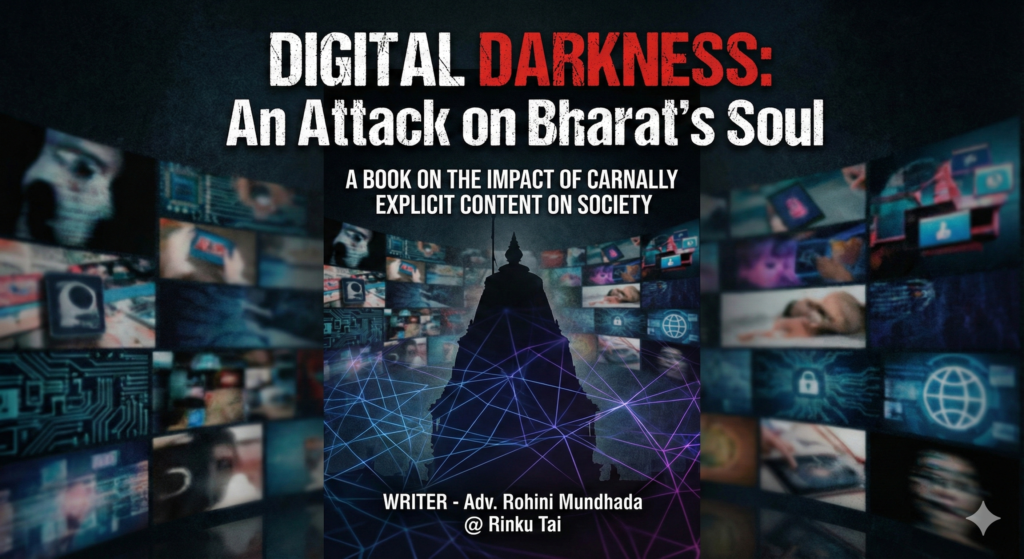
Purchase my e-book “Digital Darkness” choose your language.
Instead of doom-scrolling on mobile, just start reading good books. You can opt an option of e-books to save paper.