Behind the creation of obscene content lies not just technology but a complex web of human psychology and economic calculations. In today’s digital age, becoming a content creator has become easy, yet entering the realm of obscenity involves significant psychological pull and financial gain. In this process, fame and profit are given more importance than ethics. Without a detailed analysis of the creators’ motivations and the underlying psychology, the reasons behind this cannot be understood.
4.1 Creator Psychology: Validation through Exhibition
In the mindset of creators producing obscene or vulgar content, there is an intense hunger for social validation. In the digital world, likes, comments, and views are considered measures of success. When a person exhibits their body or private moments, the immediate fame they receive creates a kind of transient psychological satisfaction. For many, this is merely a means to attract attention. The sensational fame gained by openly presenting things that are generally considered taboo in society gives the creator a false sense of power. This mindset gradually leads the individual to fall prey to producing even more provocative content, where ethics are replaced solely by audience response.[1]
4.2 Creator Economy: When Vulgarity Becomes a Career
In the current era, producing obscene material has become an organized digital business. Many platforms allow creators to earn direct money in exchange for their content. When vulgarity acquires economic value, many young men and women begin to view it as an easy and profitable career. The allure of earning more money with less effort and in less time compared to traditional jobs keeps creators sustained in this business. Once income starts flowing from it, ethical values become secondary. Due to the ‘subscription model’, there is constant pressure on creators to provide new and more revealing content. In this way, the creator economy has given obscenity the form of a professional industry, where profit is prioritized over human dignity.[2]
4.3 Tendency to Imitate Trends
Social media algorithms often promote content that is controversial or stimulating. When novice creators see their peers or famous influencers rapidly gaining fame by using erotic styles, they too begin to imitate the same path. This is called ‘peer pressure’ or pressure from contemporaries. In the pursuit of staying in trend, many young boys and girls unknowingly start creating content that is on the borderline of obscenity. Initially, this is just a fun imitation, but gradually it transforms into seriously objectionable material. Instead of building their own unique identity, imitating the obscene style of successful creators is considered a shortcut to fame.[3]
4.4 Women as Creators: The Web of Choice and Profit
The role of female creators in the world of obscene content is extremely complicated. Some women view it as a means of self-will and financial independence, often masked as ’empowerment’. However, behind this choice, there is often economic hardship and coercion from the wrong person. Once a step is taken into this field, exiting it becomes difficult because content uploaded to the internet remains permanent. In this web of profit, a woman’s body becomes merely a product. The line between consent and exploitation is extremely blurred here. Often, due to deception by agents or intermediaries and cyber blackmailing, women are forced to remain in this quagmire.
In adolescence, many girls fall into the wrong boy’s love and also get trapped in this quagmire. The age of fourteen or fifteen is just like that; changes in the body create attraction toward the opposite sex. If one cannot maintain the right mental state during these changes and focus the mind on studies, this attraction leads to the wrong person and causes one to act according to that person’s calculations. Then, unknowingly, that tender girl does something that becomes harmful to her physical and mental health. And the boy or man with whom she did this often records the entire incident on video. The girl then becomes a victim of blackmail and gets trapped in the quagmire. For so many days, this used to happen only with girls. But now, due to excessively bizarre obscene content on the internet, boys are also starting to fall victim to it.
4.5 Exploitation of Minors: The Danger of Content Creation
The inclusion of minor girls and boys in the obscene content industry is the most alarming aspect. Lured by the glamour and money on social media, some girls and boys turn to content creation, while others fall into this quagmire due to blackmail as mentioned earlier. Sometimes, parents themselves encourage their children to create such content for fame, which is not age-appropriate.[4] Predators on the internet search for such children and drag them into obscene acts. Children often share their private information or photos without thinking about the consequences, which is later used for their exploitation. Due to lack of digital literacy and parental negligence, children get entangled in this web. This exploitation leaves permanent scars on their mental and physical health.[5]
[1] Sunnyemmanueludeze, Chikezie Emmanueluzuegbunam, “Sensationalism in the media: the right to sell or the right to tell?”, Journal of Communication and Media Research Vol. 5 No. 1, April 2013
[2] FP News Desk, “Why is ‘creator economy’ called ‘orange economy’ and why India’s betting big on it”, Firstpost, Dt. 2.5.2025, available at: https://www.firstpost.com/india/why-is-creator-economy-called-orange-economy-and-why-indias-betting-big-on-it-13885000.html, last visited on 4.12.2025
[3] Tamara Cohen, “Teenagers exposed to ‘horrific’ content online – and this survey reveals the scale of the problem” Sky News, available at: https://news.sky.com/story/teenagers-exposed-to-horrific-content-online-and-this-survey-reveals-the-scale-of-the-problem-13331556, last visited on 4.12.2025
[4] Naomi Lashley, When Kids Are the Content, Who’s Profiting? NYU law, Dt. 18.2.2025, available at: https://jipel.law.nyu.edu/when-kids-are-the-content-whos-profiting/, last visited on 4.12.2025
[5] “What is sharenting? 7 questions about sharing your children’s information online”, Unicef, available at: https://www.unicef.org/lac/en/parenting-lac/security-protection/sharenting-questions-sharing-child-information, last visited on 4.12.2025
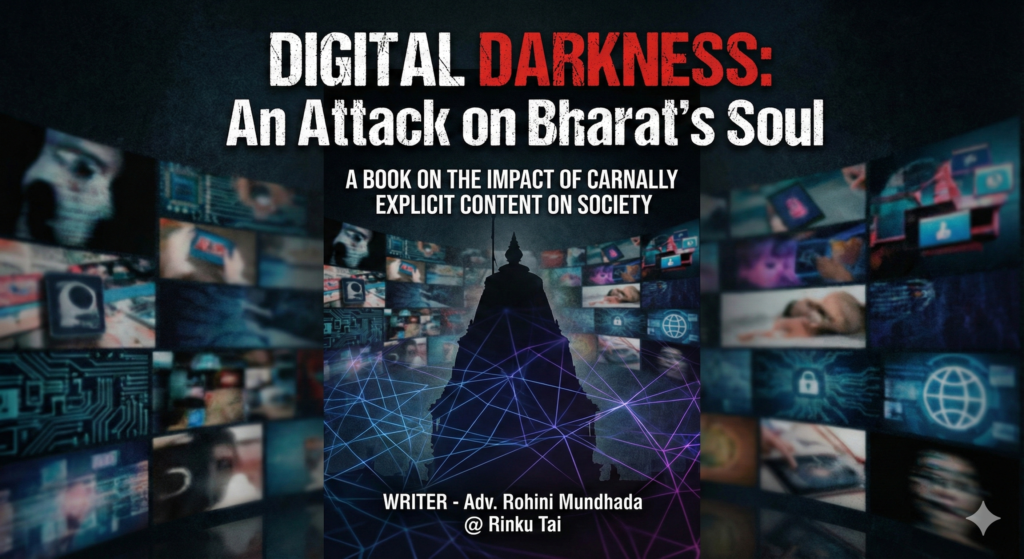
Purchase my e-book “Digital Darkness” choose your language.
Instead of doom-scrolling on mobile, just start reading good books. You can opt an option of e-books to save paper.