
Today, we are in the digital age. We can quickly accomplish every task using the internet. There was a time in this digital era when a large computer would connect to the world, and even then, ordinary people would use the internet by going to cyber cafes. But now, smartphones are in every household, and it is also a necessity of the time. During the COVID period, it was only because of smartphones that schools, colleges, and studies became possible. However, this revolution is useful to us only when we can use it properly. Today, even on educational apps and sites, advertisements displaying intimacy pop up, which is completely wrong.
3.1 Smartphone Revolution: Adult Content in Everyone’s Pocket
The advent of smartphones has brought about a revolution in information technology, but one dark aspect of this revolution is the easy availability of obscene material. Previously, the struggle to obtain such content from specific shops or secretly has now completely ended. Due to high-speed internet and affordable smartphones, this material has now reached everyone’s personal space, in their pockets. As a result, not only adults but also minors are coming into contact with such content without any obstacles. Privacy features and password locks on smartphones have made it difficult to track what a user is viewing. This ease has led to the normalization of obscenity, with deep impacts on human behavior and mindset. The solitude provided by the digital screen is contributing to the decline of moral values.[1]
3.2 Entry of Social Media: New Distributors
Social media platforms were initially created for communication, but today they have become major distributors of obscene material. Platforms like Twitter (X), Telegram, and Instagram use algorithms to promote such content. On apps like Telegram, obscene videos and photos are instantly reached to thousands through channels and groups. Provocative and obscene thumbnails are often used on these platforms to attract users’ attention. This distribution on social media happens so rapidly that controlling it poses a major challenge for cyber security systems. Many resort to this path to increase followers and gain fame, crossing the boundaries of social morality.[2]
Importantly, by disseminating such content, these public platforms earn substantial revenue. They make money through subscriptions, advertisements, monetization, and similar methods. You may think social media is free, but tech giants earn massive ad revenue by showing you viral obscene content. The creator also turns their content into a source of income through monetization, and the companies take a share of it as the platform.[3] Therefore, in this entire matter, the most important role is that of the platform. Until action is taken on the platforms, this filth will continue to pollute and sicken society.
3.3 Rise of User-Generated Content (UGC)
In the digital age, not only professional companies but ordinary users have also become content creators. This has completely blurred the boundaries of creation. Due to platforms like OnlyFans, ordinary individuals have started creating and selling their own obscene content. User-generated content has reduced the distance between professional and personal life. With the help of smart devices, anyone can record themselves and broadcast it globally. This trend has turned obscenity from merely an industry into a household activity. Serious issues such as consent, privacy, and exploitation arise in this. The ease of creation has led to a flood of obscene material, making oversight nearly impossible.[4] Strict measures are necessary before everyone is swept away in this flood.
3.4 Shield of Anonymity and Obscene Content
Anonymity in the digital world serves as a strong shield for spreading objectionable obscene content. Using fake profiles and pseudonyms, people share obscene material without any fear. These faceless profiles fuel criminal tendencies. Verbal obscenity, morphed photos, and objectionable videos are disseminated without any social responsibility. Anonymity makes users feel that no one can catch them, leading them toward more violent or perverted content. This shield encourages users toward acts like cyberbullying and sexual exploitation. Due to anonymity, moral constraints loosen, and internet use begins to be solely for unrestrained behavior, deteriorating the health of the digital environment.[5]
Using this very anonymity, incidents like honey traps occur with adults, while children and girls become disturbed by accidentally viewing obscene content. To protect everyone in the household and maintain good social health, awareness on this topic is necessary in every home. That is why this book has been written originally in Marathi and translated to Hindi and English, so that ordinary people can also read it. If you are proficient in other languages besides English, you can translate this book and participate in this campaign.
3.5 The 24/7 Cycle: Constant Access
Before the digital age, the consumption of obscene material was limited and occasional, but now it has become an uninterrupted cycle available 24/7. The internet never shuts down, so this content is accessible at any time of the day and from any location. This constant availability is increasing addiction among people. Due to perpetual access, dopamine levels in the brain become disrupted, affecting a person’s real-life relationships. This cycle is so fast that the user is continuously pulled from one video to another. Notifications on mobiles keep the influence of obscenity constantly surrounding the user. Escaping from this is becoming difficult, and this ongoing cycle is reducing human sensitivity while making obscenity an inseparable part of life.[6]
[1] Jeffrey A. Hall and Andy J. Merolla, “Loneliness and Screens: Causes and Consequences” Yale University Press, Dt. 7.6.2024 available at: https://yalebooks.yale.edu/2024/06/07/loneliness-and-screens-causes-and-consequences/, Last visited on 3.12.2025
[2] Gagandeep Kaur, Utkarsha Bonde, Kunjal Lalit Pise, Shruti Yewale, Poorva Agrawal, Purushottam Shobhane, Shruti Maheshwari , Latika Pinjarkar and RupaliGangarde, “Social Media in the Digital Age: A Comprehensive Review of Impacts, Challenges and Cybercrime”, Eng. Proc. 2024, 62, 6. Available at: https://doi.org/10.3390/engproc2024062006, Last visited on 3.12.2025
[3] Daniel Pereira, “7 Examples of How Content Creators Make Money”, Dt. 9.5.2025, Available at: https://businessmodelanalyst.com/how-do-content-creators-make-money/, Last visited on 3.12.2025
[4] Madhav Singh Bisht and Dewansh Bharadwaj, “Art, Expression and Law: When Does Creativity Cross the Line into Obscenity” LegalBites, Dt. 24.3.2025, available at: https://www.legalbites.in/topics/articles/art-expression-and-law-when-does-creativity-cross-the-line-into-obscenity-1124619, last visited on 3.12.2025
[5] “Cybercrime and the Anonymity Effect: A Deep Dive into Online Disinhibition”, Psychologs Magazine News, Dt. 19.4.2025, available at: https://www.psychologs.com/cybercrime-online-disinhibition-and-anonymity/, last visited on 3.12.2025
[6] “Porn and Dopamine: The Neurochemical Impact of Excessive Viewing”, NeuroLaunch Dt. 22.8.2024, available at: https://neurolaunch.com/porn-dopamine/, last visited on 3.12.2025
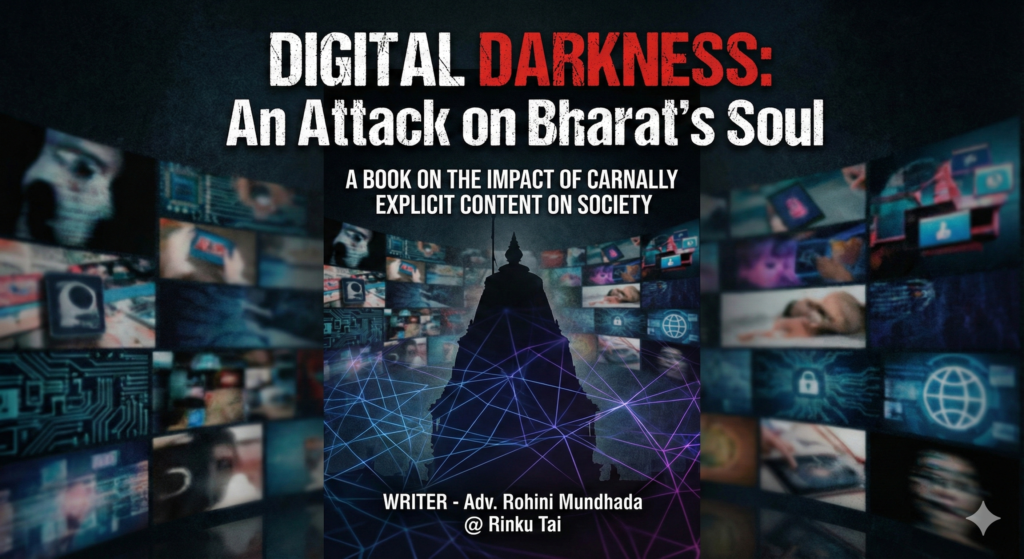
Purchase my e-book “Digital Darkness” choose your language.
Instead of doom-scrolling on mobile, just start reading good books. You can opt an option of e-books to save paper.