
In the digital age, the greatest responsibility for stopping the spread of indecent material lies with technology companies (tech giants). However, the ethics and practices of these companies have always been in the vortex of controversy. In the conflict between profit and human values, social interest is often sacrificed. In today’s era, companies running Facebook, Google, Telegram, and various adult sites have immense power. These companies do not merely provide platforms; they also decide what type of content users will see. The role of these tech giants is extremely important in the global trade of indecent material. On one hand, these companies make claims of safety, while on the other, illegal material is spread using their own platforms. The question of corporate responsibility and ethics arises here. How much are these companies responsible for the damage to society caused by indecent material, and have they neglected their ethical responsibilities solely for financial gain? This is a subject for research. The responsibility of platforms is not just legal but essential for protecting human culture.
16.1 Testing the Corporate Responsibility of Content-Hosting Tech Giants
When large technology companies host content on their servers, it is their primary responsibility to ensure that the content is legally and ethically appropriate. However, in the case of indecent material, this responsibility is often shrugged off. These companies consider themselves merely ‘intermediaries’ and argue that they are not responsible for what users upload. But when these companies earn revenue through advertisements from such content, their ethical responsibility automatically increases.
Corporate responsibility means not just earning profit but providing safe services to society.[1] On many indecent sites, videos uploaded without consent or child sexual exploitation material remain for years. These companies do not take initiative to remove it until a court order comes or there is widespread criticism. This passivity raises questions on their claims of corporate responsibility. Responsible tech giants are expected to actively search for and destroy such content, but looking at the current situation, they seem stuck in the calculus of profit.
Another reason for this is loopholes in the law, which these companies exploit and do not destroy such content themselves. Profit is visible to everyone first, and ethics is pretended to be unknown to all, this hypocrisy is rampant everywhere. Until the government makes rules declaring these companies criminally liable, this picture will not change. For example, if just the indecent material on Facebook is considered and a fine of only 1000 rupees is imposed on Facebook for each indecent post, the Bharatiya government would have enough money to modernize all government schools in the country. In places where there are no government schools, the government could establish new modern schools from these fines. But since there is no such law, social media companies easily escape from this.
16.2 Prioritizing Profit Over Safety: Allegations of Deliberate Negligence
Many tech platforms are accused of giving more importance to their financial gains than to user safety.[2] Indecent material is the most viewed and searched content on the internet. The longer a user spends on the platform, the more advertisements can be shown to them. The more advertisements a user views, the more the platform earns. This is why many platforms hesitate to impose strict bans on such content, fearing a reduction in their traffic and revenue. If they are earning by providing a platform to such material, it is the government’s responsibility to make rules and laws that can impose fines sufficient to seize the entire earnings from such indecent material.
This behavior of companies can be called ‘deliberate negligence’. Platforms know that illegal activities are happening on their sites, yet they do not implement the strict measures necessary to stop them. For example, identity verification systems are kept extremely weak so that as many people as possible can join. Instead of developing staff or advanced technology needed for safety, that money is spent on marketing. When it comes to choosing between safety and profit, most companies choose profit, which is extremely dangerous for society.
16.3 Illusion of Moderation: Why AI Fails to Grasp Cultural Nuances
Most tech companies claim to use artificial intelligence (AI) for content moderation. However, this has proven to be merely an illusion. AI is based on algorithms and cannot understand human emotions or cultural nuances. AI often makes mistakes in determining whether something is indecent or artistic. Especially in understanding cultural traditions and word structures in different countries’ languages, AI has limitations.
Often, those spreading indecent content deceive AI by altering words or making technical changes in videos. AI can only detect fixed patterns, but recognizing criminals’ new creativity is not possible for it. Moreover, the data sets used to train AI are mostly based on the Western world, leading to neglect of cultural contexts in Eastern countries. Relying solely on AI allows large amounts of indecent content to slip through filters and reach people. Moderation done without human intervention remains merely nominal.
In China, billions of indecent posts are destroyed from the internet every year; for this, they have used both human intervention and technology.[3] What China has done, we can also do. If people are trained and employed to remove such content through human intervention, millions of jobs will be created, and the idle young generation will get work.
16.4 Double Standards: Differences in Policy Enforcement between West and East
A kind of geographical double standard is seen in the policies of large tech companies. In countries like America or Europe, laws regarding indecent material are strict, and there is significant pressure on these companies there. As a result, these companies exercise more caution there and comply with local laws. However, in Bharat or other Asian countries, the enforcement of these companies’ policies is not as strict. Indecent content in local languages here is often ignored.
This is also called ‘digital colonialism’. One rule for Western countries and another for the rest of the world, this is how these companies behave. Ignoring complaints in Bharat or delaying cooperation in cyber crime investigations here are examples of this double standard. These companies earn tremendous profits from India, but they do not work with the same urgency to protect social well-being here. The root cause of this is the difference in legal strictness. Even today in India, the same old outdated laws exist. Although the Bharatiya Nyaya Sanhita applies to digital indecent material, the fine amount is so low that both those posting indecent material and the platforms acting as intermediaries trample the law with demonic laughter. Until strict financial penalties are imposed that seize entire property, this filth will continue to grow like bedbugs. We must realize that although bedbugs grow quickly, remedies can be found for them. Waiting for uniform standards at the international level would be the biggest mistake. European countries do not wait for uniform international standards. China did not wait, and America does not wait—so why does Bharat wait? Things that are causing social unrest on a large scale are not viewed with greater concern by anyone in our country. Will the country become a world leader in this way? A leader does not wait for anyone; a leader finds solutions themselves.
16.5 Ethics of Algorithms: Designed for Addiction vs Designed for Well-Being
Algorithms of indecent websites and social media on the internet are primarily created to ‘keep users engaged’.[4] These algorithms are designed by finding weak links in the human brain. Once a user views indecent content, the algorithm starts recommending more provocative content of the same type. This design is fundamentally created to push the user into the pit of addiction, known as ‘attention economy’.
Ethically, technology design should be for the user’s welfare and health. However, in the case of indecent material, it is completely the opposite. The algorithm does not know whether the user is a minor or suffering mental distress from this material; it only cares about clicks and watch time. If these companies had truly considered ethics, they would have created features to warn users after viewing such content or suggest taking a break. This technical design for addiction is destabilizing human psychology, and for the greed of profit, this is the biggest unethical use of technology.
While researching this topic and preparing evidence-based petitions for the government, I saw many obscene accounts on various social media, and such content still appears in my feed. At least once a day, I report such posts and block those accounts. The filth is so much that one person cannot clean it alone—that is why I repeatedly say this is work that everyone must do together. At the very least, you can report and block such posts, and at most, if you know the address of such a creator, you can file a police complaint. Under the IT Act, there is a financial penalty of 10 lakhs for such content.
[1] “What Is Corporate Social Responsibility? Key Insights”, Santa Clara University, available at: https://www.scu.edu/business/blog/business-concepts/what-is-corporate-social-responsibility/, last visited on 16.12.2025
[2] Jim Osman, “Big Tech’s Overpowering Influence: Risks To Markets And Your Money” Forbes, Dt. 30.6.2024, available at: https://www.forbes.com/sites/jimosman/2024/06/30/big-techs-overpowering-influence-risks-to-markets-and-your-money/, last visited on 16.12.2025
[3] Agence France-Presse, “China targets soft porn, vulgar trends on internet to protect children”, India Today, Dt. 13.7.2024, available at: https://www.indiatoday.in/world/story/china-crackdown-against-harmful-content-on-internet-to-protect-children-2566314-2024-07-13, last visited on 16.12.2025
[4] Muhammad Tuhin, “Social Media Algorithms: How They Control What We See”, Science News Today, Dt. 27.3.2025, available at: https://www.sciencenewstoday.org/social-media-algorithms-how-they-control-what-we-see, last visited on 16.12.2025
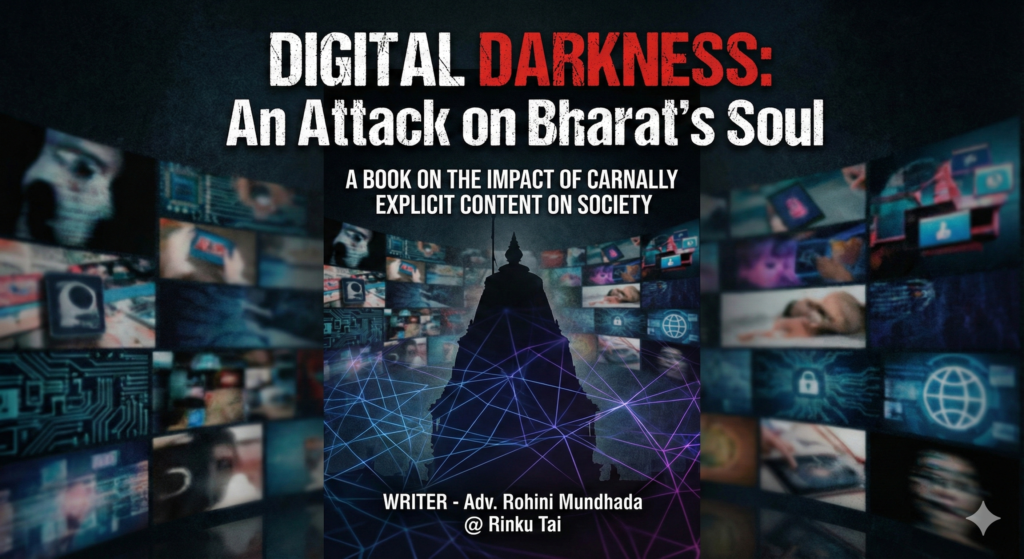
Purchase my e-book “Digital Darkness” choose your language.
Instead of doom-scrolling on mobile, just start reading good books. You can opt an option of e-books to save paper.