
Introduction
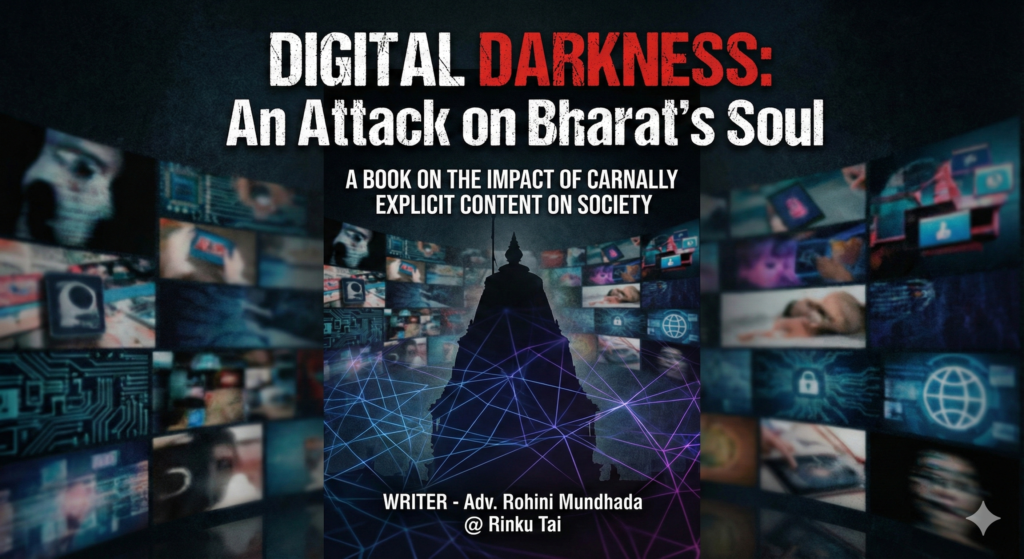
As Bharat consumes data at an unprecedented rate, a profound internal conflict arises. In this era of the digital world, even children know how to watch videos on mobile devices before going to school. Bharatiya citizens are using this technology on a massive scale, forming one of the largest societies on the planet consuming information from the internet and specifically from social media. This exploration delves into the psychological tension experienced when values absorbed through our cultural heritage clash with the depraved or corrupting influences found online. Individuals often resolve this discomfort by normalizing behavior previously considered contrary to societal morality, leading to a gradual shift in the national psyche. The horrible decline of this normalization could lead to a broken society if left unanswered, as such content is currently fueling the prurient interests of the general public. This topic examines these dynamics, with a particular focus on the impact of carnally explicit content, drawing on psychological concepts, statistical trends, and societal implications to highlight the urgent need for awareness and intervention.
Understanding Cognitive Dissonance
Cognitive dissonance, a theory first proposed by psychologist Leon Festinger in 1957, refers to the mental discomfort experienced when an individual holds two or more contradictory beliefs, values, or ideas simultaneously.[1] In the digital age, this manifests as a clash between traditional values and modern online behaviors. For instance, users may encounter content that challenges their ingrained cultural norms, leading to emotional distress such as anxiety or guilt. To alleviate this, people often adjust their attitudes or rationalize their actions, a process that can erode personal integrity over time.
In the context of social media, cognitive dissonance is exacerbated by the pressure to conform to online trends while maintaining offline identities, creating a “silent struggle” for many, particularly youth who curate perfect digital facades at the cost of their mental health. [2] Studies show that this dissonance is not just individual but can permeate social networks, leading to dysfunctional group thinking where biases amplify and rational discourse diminishes. In Bharat, where ancient cultural values emphasize dharma (moral duty) and self-restraint, the influx of Western-influenced digital content heightens this tension, forcing individuals to navigate a precarious balance between heritage and modernity.
Whole internet is flooded with carnally explicit material. It is often named as western influence. But even western countries are having problems due to easy availability of such content. Somewhere such kind of posts including verbal, pictorial and even in forms of videos is harming the social fabric of every nation, as such content is encouraging the prurient interests of users. Such encouragement is abetting outraging of modesty and leading to the carnal assaults. Hence this is not the problem of one nation like Bharat, it is problem of humanity apart from nations and religions.
The Surge of Digital Consumption in Bharat
Bharat’s digital landscape has exploded in recent years, with internet penetration reaching approximately 55-67% of the population by 2025, encompassing over 800 million users.[3] This growth is driven by affordable smartphones, widespread 5G adoption, and rural connectivity initiatives, resulting in mobile data consumption valued at INR 726.10 billion in 2024 and projected to soar to INR 2.21 trillion by 2030.[4] Social media platforms are central to this consumption, with 491 million active users engaging daily for entertainment, information, and social interaction.[5] All this data is also proudly published on the site or Press Information Bureau, a government owned entity.
Children as young as preschool age are exposed to screens, often learning to navigate apps before formal education begins, which normalizes early digital immersion. However, this unprecedented access brings not just opportunities but also risks, as unfiltered content floods into homes, challenging traditional family structures and community values. Rural areas, with a penetration rate of about 46%, are catching up rapidly, bridging the urban-rural divide but also amplifying exposure to potentially corrupting influences across diverse socioeconomic strata. [6]
Governments of all countries including Bharat are aware of the data consumption by the citizens, but still no fruitful steps are being taken in these States to prevent the spread of carnally explicit content. China is having its own policies and implementing it effectively.[7] Even United States of America (USA) is having strict laws to address the grievance of general public.[8] But undeveloped nations, developing nations and even developed western nations are still not having any policy to tackle this problem.
Clash between Cultural Heritage and Online Influences
Bharat’s rich cultural heritage, rooted in ancient texts like the Vedas and epics such as the Ramayana and Mahabharata, promotes ideals of modesty, respect, and spiritual growth. Yet, the digital realm often presents contrasting narratives, such as glorifying materialism, individualism, and instant gratification, create a profound cultural dissonance. Social media algorithms prioritize sensational content, leading users to encounter material that contradicts familial teachings on morality and restraint. For example, young Bharatiyas may uphold vegetarianism or family-oriented values at home while engaging with content promoting consumerism or hedonism online, triggering internal conflict.[9] This clash is particularly acute in subcultures like gaming zones, where participants minimize psychological distress by rationalizing deviant behaviors as part of an “oppositional” identity. The result is a fragmented psyche, where individuals compartmentalize their lives: pious in person, permissive in pixels. Over time, this erosion of cultural anchors contributes to a broader societal shift, as collective norms bend under the weight of digital influences.[10]
The Impact of Carnally Explicit Content
In Bharat, where societal morality traditionally emphasizes purity and family honor, this content fuels prurient interests, leading to a “horrible decline” in communal values and potentially breaking down social fabrics if unchecked. Carnally explicit content, commonly referred to as pornography, represents one of the most insidious elements fueling cognitive dissonance in Bharat. Statistics reveal that explicit content accounts for 30-70% of internet traffic in Bharat, with the average age of first exposure around 11-14 years. Female viewership has risen to 30%, surpassing global averages, indicating a democratizing yet alarming trend.[11] These numbers are horrific and the disturbing truth is distorting image of Bharat, where family values are the foundation stone of the society. Hence it is necessary to take strict steps to restrict such content.
Psychologically, consumption is linked to increased stress, anxiety, depression, and problematic use patterns, where individuals experience conflicting emotions, i.e. pleasure mingled with guilt, exacerbating dissonance. On an individual level, it can lead to unrealistic expectations in relationships, reduced sexual satisfaction, and heightened aggression, as users normalize behaviors that clash with cultural taboos on premarital intimacy or objectification.[12] Societally, it perpetuates violence and abuse, ruins marriages, and fosters addiction, with studies showing correlations to emotional and conduct problems, especially among adolescents.[13]
Mechanisms of Resolving Dissonance: Normalization and Its Perils
To resolve the discomfort of cognitive dissonance, individuals often employ strategies like normalization, where once-taboo behaviors become acceptable through repeated exposure. In the digital context, this might involve justifying explicit content consumption as “harmless entertainment” or aligning it with modern “freedom,” despite conflicting with heritage values. Social media amplifies this by creating echo chambers that reinforce such rationalizations, reducing dissonance through group validation. However, this process carries perils: it leads to habit-forming behaviors, impaired mental health, and a gradual desensitization to moral boundaries. [14]
For Generation Z in Bharat, the “endless cycle” of addiction stems from early exposure, perpetuating a loop of consumption and justification that erodes self-control. Over time, this normalization shifts the national psyche, making depraved influences mainstream and weakening the cultural safeguards that once protected societal harmony.[15] Many people thinks that prohibiting teenagers from using social media will be effective. Prohibiting young-ones, full of energy may lead to protests like Nepal. Instead of prohibiting individuals, why can’t government prohibits platforms spreading such contents?
Societal Consequences and the Path Forward
The unchecked normalization of conflicting digital influences poses severe consequences for Bharat’s society. It risks creating a “broken society” marked by increased psychological distress, family breakdowns, and cultural erosion, as prurient content fuels widespread addiction and aggression. Youth, in particular, face heightened emotional problems and unrealistic attitudes, potentially leading to a generation disconnected from their roots. To counter this, interventions must include digital literacy programs that teach critical thinking and value alignment, stricter content regulations, and community initiatives promoting cultural education.[16] Psychological support for those experiencing dissonance, such as therapy addressing problematic use, is crucial. By fostering awareness and encouraging mindful consumption, Bharat can mitigate these risks and preserve its moral fabric. Hence I am writing this book to create awareness among people.
In the digital age, cognitive dissonance represents a silent battle within Bharat’s collective consciousness, intensified by rampant data consumption and the infiltration of carnally explicit content. As individuals normalize clashes between heritage and online depravity, the national psyche risks irreversible shifts toward fragmentation. Addressing this requires a concerted effort to reclaim cultural values while navigating technological advancements, ensuring that progress does not come at the cost of societal integrity. Only through proactive measures can Bharat avert the “horrible decline” and foster a harmonious digital future. Let us explore the effective measures to resolve this problem through this book/article series.
[1] “When the Mind Clashes – Understanding Cognitive Dissonance”, Softminds, Dt. 24.4.2023, available at https://www.softmindindia.com/Blog/When-The-Mind-Clashes-Understanding-Cognitive-Dissonance, Last visited on 19.12.2025
[2] Gem SK, “Behind The Screen: The Silent Struggle of India’s Youth”, Reflections, Dt. 8.12.2025, available at https://reflections.live/articles/25624/behind-the-screen-the-silent-struggle-of-indias-youth-by-gem-sk-27407-mix9sjy9.html, Last visited on 19.12.2025
[3] “Dominating the Internet Landscape: Global Internet Usage Statistics by Country in 2025”, SG Analysis, available at: https://www.sganalytics.com/blog/global-internet-usage-statistics/, Last visited on 19.12.2025
[4] “India Mobile Data Consumption Trends Report 2025: Consumption to Soar by 2030, Powered by 5G, Streaming, and Smartphone Boom – ResearchAndMarkets.com”, BusinessWire, Dt. 23.9.2025, available at: https://www.businesswire.com/news/home/20250923381089/en/India-Mobile-Data-Consumption-Trends-Report-2025-Consumption-to-Soar-by-2030-Powered-by-5G-Streaming-and-Smartphone-Boom—ResearchAndMarkets.com, Last visited on 19.12.2025
[5] Sue Howe, “Social Media Statistics for India [Updated 2025]”, Meltwater, Dt. 14.3.2025, available at: https://www.meltwater.com/en/blog/social-media-statistics-india, Last visited on 19.12.2025
[6] “Satellite Internet in India: The Future of Internet Above Us”, PIB, Dt. 23.09.2025, available at: https://www.pib.gov.in/PressNoteDetails.aspx?NoteId=155262&ModuleId=3®=3&lang=1, Last visited on 19.12.2025
[7] Zhang Yi, Liu Kun, “Government moves to clean up internet content”, China Daily, Dt. 5.3.2018, available at: https://www.chinadaily.com.cn/a/201805/03/WS5aea53eba3105cdcf651baab.html, Last visited on 19.12.2025
[8] “Citizen’s Guide To U.S. Federal Law On Obscenity”, Criminal Division US Department of Justice, available at: https://www.justice.gov/criminal/criminal-ceos/citizens-guide-us-federal-law-obscenity, Last visited on 19.12.2025
[9] Tani Khara, “A cross cultural meat paradox: A qualitative study of Australia and India”, Science Direct, available at: https://www.sciencedirect.com/science/article/abs/pii/S0195666321001343, Last visited on 19.12.2025
[10] Chakrapani Upadhyay, “Indian Gaming Zones as Oppositional Subculture”, The University of Chicago Press Journal, available at: https://www.journals.uchicago.edu/doi/10.1086/717769, Last visited on 19.12.2025
[11] Jannik Lindner, “Internet Pornography Statistics”, Gitnux, Dt. 13.12.2025 available at: https://gitnux.org/internet-pornography-statistics/, Last visited on 19.12.2025.
[12] M. Rajashekar, Manoj Kumar Sharma &Senthil Amudhan, “Problematic Pornography Use Among Indian Adults: Patterns, Preferences, Motives, Psychosocial Impacts, and Support Strategies”, Taylor and Francis, available at: https://www.tandfonline.com/doi/abs/10.1080/19317611.2025.2584545, Last visited on 19.12.2025
[13] “Porn: The Widespread Taboo”, Seattle Anxiety Specialists, Dt. 24.7. 2023 available at: https://seattleanxiety.com/psychiatrist/2023/7/14/exploring-the-psychological-impacts-of-pornography, Last visited on 19.12.2025
[14] Claudio Vieira & Mark D. Griffiths, “Problematic Pornography Use and Mental Health: A Systematic Review”, Taylor and Francis, Dt. 10.5.2024, available at: https://www.tandfonline.com/doi/full/10.1080/26929953.2024.2348624#references-Section1, Last visited on 19.12.2025
[15] Kirsten Weir, “Is pornography addictive?”, American Psychological Association, available at: https://www.apa.org/monitor/2014/04/pornography, Last visited on 19.12.2025
[16] “Digital Literacy interventions – a guide for organizations working in forced displacement contexts”, UNHCR Innovation Service, February 2025
Send an email by clicking the red button below! As you click the button an automatic mail will be ready for you to send. This email is addressing to Chief Ministers of all states of Bharat and Prime Minister of Bharat.
As you have sent the Email, share this article with others. Greater the social issue, more awareness is required!



Want to curb social media addiction, start reading!
Pingback: The Digital Transformation of Vice: Part 1 – bharatlex-rinkutai.com