
A Look Back at How Laws and Norms Regarding Carnally Explicit Material Have Evolved, Setting the Stage for the Current Crisis
Introduction
The evolution of laws and societal norms surrounding carnally explicit material, often euphemistically termed as “obscenity” or “lewdness”, in Bharat reflects a complex interplay between cultural heritage, colonial codes, technological advancements, and ideological battles. From ancient temple carvings depicting eroticism to the digital proliferation of pornography in the 21st century, Bharat has grappled with defining the boundaries between artistic expression, moral decency, and outright vulgarity.[1] This article traces this historical trajectory, highlighting how regulations have sought to protect societal values against the encroachment of permissive ideologies. Same is applicable in other western countries, as dressing sense of western people, even a century ago was covering whole body with multiple layers of clothes. The Victorian code of covering whole body changed the perspective. When Europeans entered in Bharat, they found that people living here were having variety of clothing depending upon their region and based on the environment.
At the heart of this discussion lies a critique of contemporary woke and liberal perspectives that frame vulgarity as an unassailable form of free speech. Proponents of this view, often rooted in Western individualistic notions of liberty, argue that any restriction on explicit content infringes upon fundamental rights, dismissing concerns about moral decay, exploitation, and cultural erosion as archaic conservatism.[2] However, this narrative overlooks the profound societal harms inflicted by unchecked explicit material: the objectification of women, the normalization of deviant behaviors, and the undermining of family structures in a collectivist society like Bharat.
By examining historical developments, this paper contends that obscenity laws have not been tools of oppression but necessary safeguards against the commodification of human dignity. As life with dignity is one of important fundamental right under Article 21 of the Constitution of Bharat[3], protection of such right is not at all oppression. Content of such kind depicts women and girls in bad light and objectify them. Far from stifling creativity, these regulations have historically balanced expression with ethical responsibility, setting the stage for today’s crisis where digital platforms amplify vulgarity under the guise of empowerment.[4]
This analysis is structured around key historical phases and debates, drawing on legal, cultural, and judicial milestones to demonstrate why equating vulgarity with free speech is not only misguided but dangerous. In an era where explicit content fuels addiction, harassment, and social fragmentation,[5] revisiting this history underscores the need for renewed vigilance rather than liberalization.
From Colonial Penal Codes to the Digital Age: A Legal History
The foundations of Bharat’s obscenity laws were laid during British colonial rule, importing Victorian code of moral standards into a culturally diverse subcontinent. The Indian Penal Code (IPC) of 1860, enacted under Lord Macaulay’s influence, introduced Section 292, which criminalized the sale, distribution, or exhibition of “obscene” materials deemed to corrupt those whose minds were open to such influences.[6] This provision drew from the English Obscene Publications Act of 1857, reflecting colonial anxieties over native immorality and the need to impose Western propriety.[7] Prior to colonization, Bharatiya society had no uniform legal framework for obscenity; instead, local customs and religious texts like the Manusmriti addressed carnal propriety through social norms rather than codified law.
Post-independence in 1947, Bharat retained much of the IPC, adapting it to a sovereign context. The 1950s and 1960s saw amendments strengthening obscenity provisions, such as the 1969 addition of Section 293, which imposed harsher penalties for offenses involving minors. These changes were driven by concerns over imported Western media eroding traditional values, particularly in a newly independent nation striving to forge a moral identity.[8] Critics of liberal views might note here how early postcolonial leaders recognized the risks of unbridled expression: the then government of Bharat, while championing secularism, supported censorship to prevent communal discord and moral laxity, countering the notion that free speech should encompass vulgarity without consequence.[9]
The 1970s and 1980s marked a period of intensification amid rising feminist movements and debates over women’s portrayal.[10] The Indira Gandhi era’s Emergency (1975-1977) amplified state control over media, including obscenity, though this was more politically motivated than morally driven.[11] By the 1990s, economic liberalization exposed Bharat to global media, prompting further legal refinements. The Cable Television Networks (Regulation) Act of 1995 aimed to curb explicit content on TV, reflecting fears that Western influences were diluting Bharatiya ethos.[12]
The digital age, commencing in the late 1990s, revolutionized this landscape. The Information Technology (IT) Act of 2000 introduced Sections 67, 67A, and 67B, addressing electronic transmission of obscene material, including pornography and child exploitation.[13] This was a response to the internet’s anonymity and accessibility, which liberals hailed as democratizing expression but which, in reality, facilitated widespread dissemination of vulgar content. Amendments in 2008 enhanced penalties, recognizing the internet’s role in amplifying harms like cyber harassment and addiction.[14] Today, under the Bharatiya Nyaya Sanhita (BNS) replacing the IPC in 2023, obscenity provisions persist, albeit with modern adaptations for digital platforms under Sections 294 and 295.[15] So there was always a law to prohibit any kind of distribution of obscene material.
Why these laws were in force from time to time, even in customary forms? Because carnal intimacy is very private act between two persons, and a social moral suggested since unknown era of time, that this thing shall not be done publicly and its public presentation was also restricted in every corner of human residences including those of western countries. As you can’t poop and pee in front of others, you can’t intercourse in front of others. Every human society had its rules for committing carnal activity and breaking such rules was considered as sin. Hence there are such rules. Who are these people who support public presentation of carnally explicit activates? Are they educated enough of human values?
Against liberal claims that such laws stifle free speech, this history reveals a pattern: regulations evolved not from authoritarianism but from necessity. Colonial codes imposed foreign morals, but post-independence adaptations protected indigenous values from exploitative globalization. The digital era’s challenges which are evidenced by rising cases of online obscenity, underscore how unchecked “free speech” enables exploitation, particularly of vulnerable groups, rather than empowering them. Liberals’ dismissal of these laws as outdated ignores their role in preserving societal harmony, perpetuating a narrative that prioritizes individual gratification over collective wellbeing.
[1] Sensual Divinity: The Sexual Artistic Trends of 3rd Century Ancient Indian Sculpture, The Archeologist, https://www.thearchaeologist.org/blog/sensual-divinity-the-sexual-artistic-trends-of-3rd-century-ancient-indian-sculpture
[2] Censorship vs. Free Expression: The Controversy Surrounding Book Banning, In Education, https://ineducationonline.org/2023/09/22/censorship-vs-free-expression-the-controversy-surrounding-book-banning/
[3] Article 21 of India’s Constitution: Right to Life and Liberty Explained, Faculty Adda, https://www.facultyadda.com/2025/06/article-21-right-to-life-india.html
[4] The New Normal: A Culture of Abuse and Vulgarity – Where Are We Headed?, Rahul Narain Sharma, https://www.linkedin.com/pulse/new-normal-culture-abuse-vulgarity-where-we-headed-sharma-hyqmc
[5] How Social Media Fuels Porn Addiction – 5 Ways to Break Free, CSPMA, https://cspma.org/the-modern-struggle-how-social-media-fuels-porn-addiction-what-you-can-do-about-it/
[6] Law of Obscenity and Freedom of Expression: Where to Draw the Line, SCC online, https://www.scconline.com/blog/post/2022/07/21/law-of-obscenity-and-freedom-of-expression-where-to-draw-the-line/
[7] Evolving Dimensions of Obscenity Law: A Lesson for India from the Jurisdictions of UK and US, SSRN, https://download.ssrn.com/2024/6/22/4873281.pdf
[8] IPC Section 293: Sale, etc., of obscene objects to young person, IPC Laws, https://ipclaws.in/ipc/section-293/
[9] Censorship Laws in India: A Journey from Royal Decrees to the Digital Frontier, Historified, https://historified.in/2025/07/08/censorship-laws-in-india-a-journey-from-royal-decrees-to-the-digital-frontier/
[10] Women’s Movements in India Since the 1970s: Addressing Dowry, Violence, and Political Participation, Socio Health, https://socio.health/gender-and-society/womens-movements-india-dowry-violence-politics/
[11] The Emergency (India), Scholarly Community Encyclopedia, https://encyclopedia.pub/entry/34578
[12] Cable Television Networks (Regulation) Act, 1995: A Detailed Analysis, LawBhoomi, https://lawbhoomi.com/cable-television-networks-regulation-act-1995/
[13] Section 67A & 67B IT Act: Punishment for Obscene and CSAM Content, Legal Bihar, https://legal.bihar.in/section-67a-67b-it-act-punishment-for-obscene-and-csam-content/
[14] IT Act 2000 and IT (Amendment) Act 2008., NotesWorld, https://notesworld.lifeofregret.blog/posts/it-act-2000-and-it-amendment-act-2008/
[15] Bharatiya Nyaya Sanhita (BNS) 2023: A Complete Guide to India’s New Criminal Code, My Law Rights, https://mylawrights.com/bharatiya-nyaya-sanhita-bns/
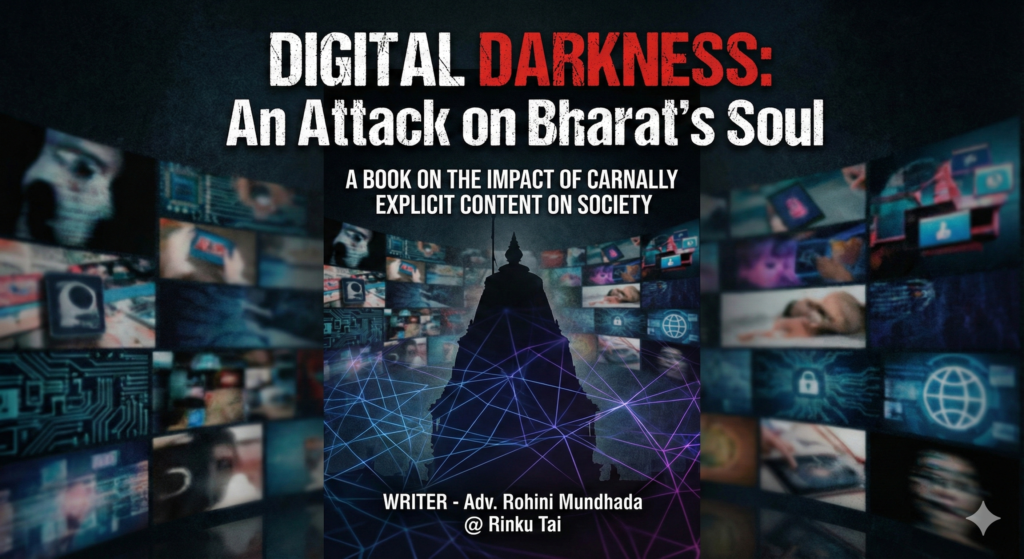
Send an email by clicking the red button below! As you click the button an automatic mail will be ready for you to send. This email is addressing to Chief Ministers of all states of Bharat and Prime Minister of Bharat.
As you have sent the Email, share this article with others. Greater the social issue, more awareness is required!

Want to curb social media addiction, start reading!
Identifying Digital Propaganda vs. Freedom of Expression
Bharat under Siege: The Obscene Material Flood on Social Media Owned by Tech Giants