
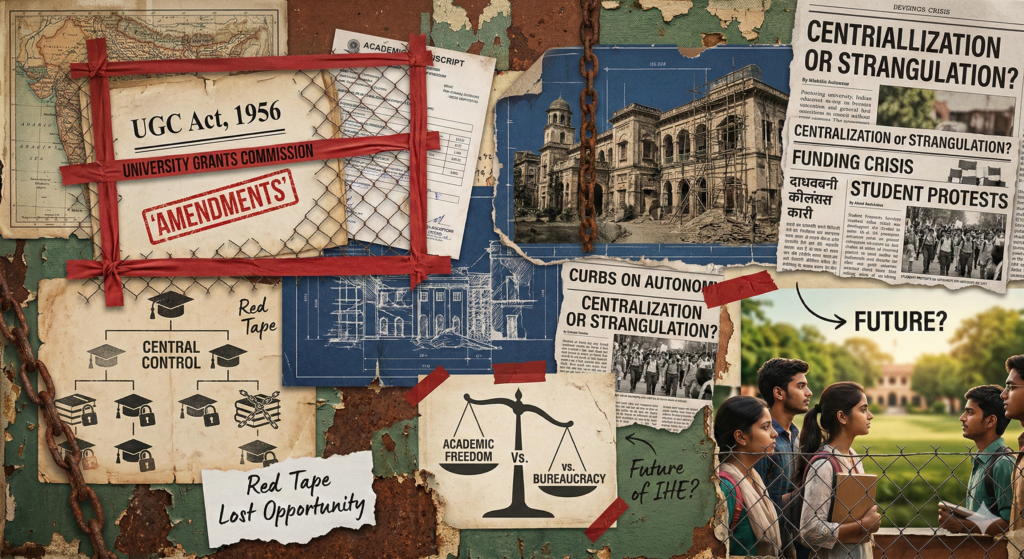
2.1 Bare Act Provision
CHAPTER I PRELIMINARY
1. Short title and commencement.—
(1) This Act may be called the University Grants Commission Act, 1956.
(2) It shall come into force on such date1 as the Central Government may, by notification in the Official Gazette, appoint.
Footnote from Bare Act:
1. 5th November, 1956, vide notification No. S.R.O. 2608, dated 1st November, 1956, see Gazette of India, Extraordinary, Part II, sec. 3.
2.1 Explanation:
The UGC Act came into force (in terms of Section 1(2) thereof) on its publication in the Gazette of India on 05.11.1956.[1] The enactment of UGC Act is also traceable to Entry 66 of List I.[2] The UGC Act was enacted to make provisions for the coordination and determination of standards in the Universities with the mandate to take such steps as it may think fit for the promotion and coordination of University Education and for the determination and maintenance of standards of teaching, examination and research in Universities.
In 1950s, several institutions styling themselves as `universities’ had started awarding degrees and diplomas which had no basis and could not be accepted. Keeping in view the mischief which was sought to be eradicated and the consideration which weighed with Parliament to introduce the prohibition in UGC Act. It must be noted that UGC Act recognises only those institutions established or incorporated under special statutes of sovereign legislatures.[3] The UGC Act, indisputably, governs deemed universities and open universities also.[4]
The function of the university is not only to preserve, disseminate and advance knowledge but also to furnish intellectual leadership and moral tone to society. No less important is the role of universities in promoting national integration and a common culture, and in bringing about the social transformation that is desired. Finally, universities have also to provide trained personnel to advance the country’s prosperity by making full use of modern knowledge.[5]
The standard of education in an institution depends on various factors like, (i) the caliber of teaching staff; (ii) a proper syllabus designed to achieve high level of education in a given span of time; (iii) the student-teacher ratio; (iv) equipment and laboratory facilities; (v) caliber of the students admitted; (vi) adequate accommodation in the institution; (vii) the standard of examinations held including the manner in which the papers are set and examined; and (viii) the evaluation of practical examinations done. It was pointed out that education involves a continuous interaction between the teachers and the students. The base of teaching, the level to which teaching can rise and the benefit which the students ultimately receive depends as much on the caliber of the students as on the caliber of the teachers and the availability of adequate infrastructural facilities.[6]
Although the role of universities is clearly explained by the eminent judiciary of this nation, elite universities like Jawaharlal Nehru University, are full of elements which are creating caste and religion based enmity by organizing protests on this or that occasion. These universities are also echoed with slogans of “Bharat Tere Tukde Honge”, “Brahmanwad Se Azadi”, “Brahman Baniya Bharat Chhodo” which are full of hatred and harmful for national unity and internal security. From the glasses of statute, these matters are of criminal jurisdiction and proper police complaint is needed in such matters, but UGC had closed it’s eyes on these matters of crucial importance for social fabric of this nation, and this is unjust failure of the statutory machinery.
The level of education and specifically of that higher education is derailing day by day. UGC is not even taking any effort to promote innovative study, updated syllabus for various streams, job ready education for all. In recent outrage against UGC, it had been claimed that UGC have planned the promotion British era policing through equity squads and caste consciousness in students by enforcing new equity regulations in 2026. Although these regulations were stayed by the Supreme Court, when I was writing this book, but it sparked people to point out that UGC, as an authority had failed to maintain its goals. As globalization is at its peak and multi-national companies are hiring talented youth, standard of higher education is in bad shape with serious concerns. Nation is demanding reforms in educational sectors.
[1] Kumaon Institute of Education and Technology Vs. Uttarakhand Open University and another, Uttarakhand High Court, Special Appeal No. 899 of 2019
[2] Asson. Of Mgmt. Of Private Colleges vs All India Council For Tech.Edu.& Anr, Supreme Court, [CIVIL APPEAL NO. 1145 OF 2004 Connected with CIVIL APPEAL NOS. 5736-5745 OF 2004]
[3] Prem Chand Jain & Anr vs R. K. Chhabra [1984 CHANDLR(CIV&CRI) 265]
[4] Sikkim Manipal University vs Indira Gandhi National Open University [AIR 2016 (NOC) 155 (SIK.)]
[5] Prof. Yashpal & Anr vs State Of Chhattisgarh & Ors [2005 AIR SCW 1168]
[6] Prof. Yashpal & Anr vs State Of Chhattisgarh & Ors [2005 AIR SCW 1168]
![UGC NET Law Paper 2 and Mock Test Papers Books 2026 [2 Books Set]...](https://m.media-amazon.com/images/I/51Qbo7qfsnL.jpg)
Pingback: 23. UGC Act: Section 20 – bharatlex-rinkutai.com