
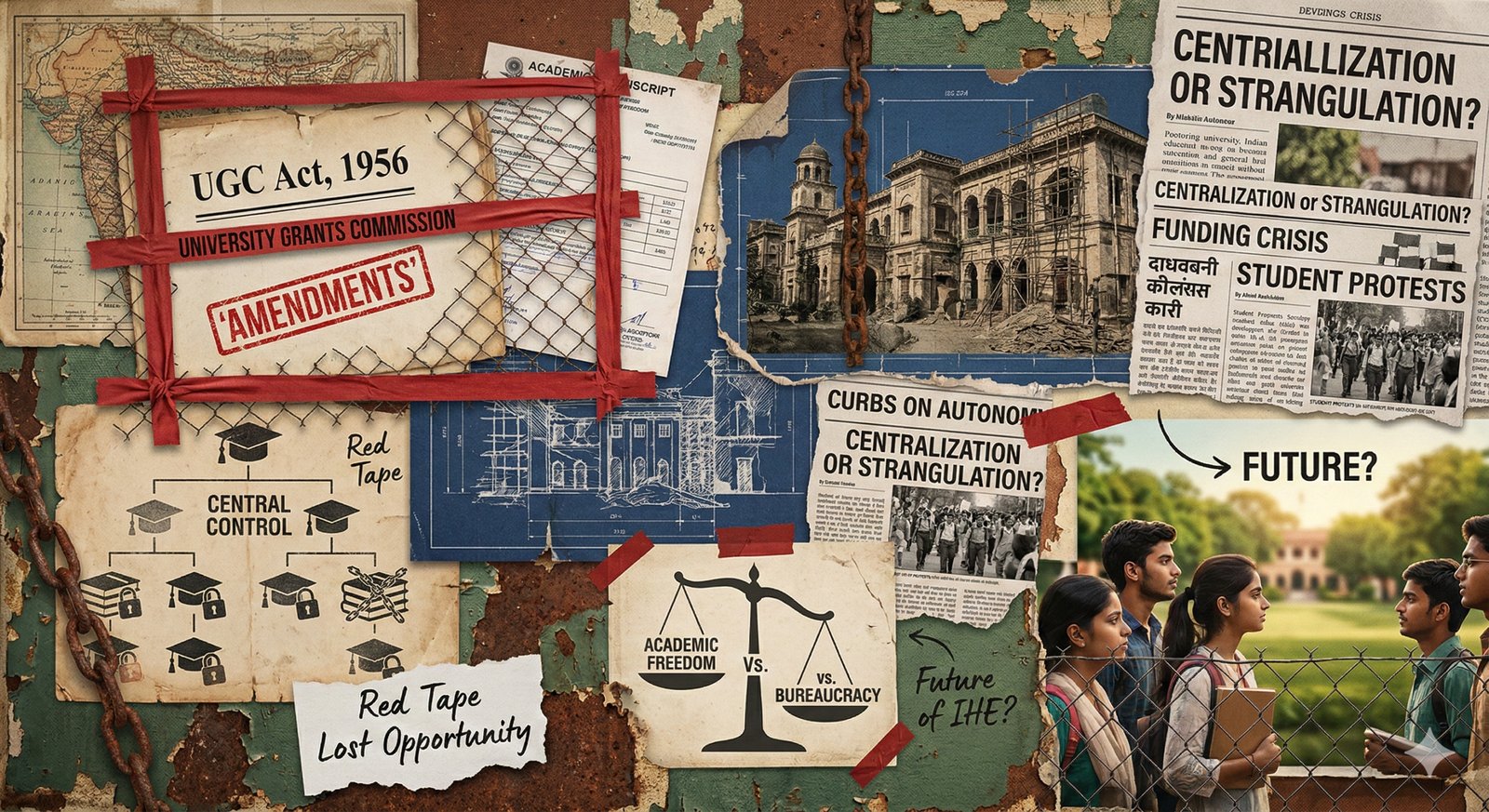
Image Courtesy: Gemini AI.
A Critical Analysis of the UGC Act and the Future of Indian Higher Education
Introduction
The landscape of Indian higher education presents a profound and troubling paradox. On one hand, the nation boasts one of the largest systems of higher learning in the world, overseen by the University Grants Commission (UGC), a centralized statutory body armed with expansive powers to coordinate, determine, and maintain standards. On the other hand, there is a palpable sense of decay. From the corridors of ancient state universities to the glass facades of modern private institutions, a common sentiment prevails now a days that the standard of higher education in India is derailing. Despite the presence of a dedicated central authority, the quality of research, the relevance of curricula, and the global standing of Indian degrees continue to face intense scrutiny and skepticism.
This decline is not merely a matter of lack of funding or infrastructure; it is a systemic failure rooted in the very legal architecture designed to protect it. The UGC Act of 1956 was envisioned as a beacon of academic excellence, yet decades later, it often feels more like a regulatory cage. This article series, and the comprehensive book that follows, embarks on a forensic, section-by-section critical analysis of the UGC Act. This explores how this singular piece of legislation asserts its prevalence over almost every other higher educational provision in the country, often creating a stifling environment where compliance is valued over innovation.
If the UGC was established to ensure high standards, why do we find ourselves in a state of academic stagnation? To answer this, it moves beyond superficial summaries and dive into a critical analysis of the Act’s significance and its interpretation by the judiciary. It examines how various High Courts and the Supreme Court have grappled with the overlap of powers between the UGC and other professional councils, revealing a complex web of legal superiority that frequently leads to administrative paralysis.
One of the most provocative themes of this series is the investigation in to the hidden colonial policies embedded within the Act. Many of the procedural frameworks still in use today are relics of a bygone era, designed more for colonial administrative control than for the intellectual liberation of a sovereign nation. These “ghosts of the Raj” manifest as rigid hierarchies, excessive centralism, and a deep-seated distrust of institutional autonomy. By exposing these colonial residues, it highlights the lacunae that breed procedural delays, which can stall a university’s progress for years over minor bureaucratic technicalities.
Each article in this series is a deep dive into a specific facet of the Act. If analyzes the loopholes that allow for the proliferation of “degree mills” while simultaneously strangling legitimate institutions with red tape. It looks at Section 12 and the Commission’s power to distribute grants, questioning whether financial leverage has become a tool for conformity rather than a catalyst for growth. It scrutinizes the regulations regarding the appointment of Vice-Chancellors and faculty, where the friction between state autonomy and central mandates often results in a total breakdown of governance.
The urgency of this analysis cannot be overstated. As India seeks to position itself as a global knowledge superpower, it cannot afford to be tethered to an outdated and often contradictory regulatory regime. The “Regulatory Cage” is not just a metaphor; it is a reality for thousands of educators and millions of students who find their potential capped by systemic inefficiency. This series serves as a roadmap for reform, identifying exactly where the gears of the UGC Act are grinding and where they have seized up entirely. By the time you reach the final installment, you will see the Indian higher education system through a new lens, not as a chaotic sprawl, but as a system held in check by its own founding legislation.
For the legal professional, the academician, and the policy maker, these articles provide the raw data and critical interpretation needed to advocate for change. However, the individual articles are only pieces of a larger puzzle. To truly grasp the magnitude of the challenge and the potential for a new era of Indian academia, the complete book is essential. The book compiles these analyses into a singular, cohesive narrative, offering all the articles under single umbrella and a vision for a post-UGC regulatory landscape.
Join me as “we” to unlock the Regulatory cage of UGC Act. Explore the interpretations, challenge the hidden biases, and confront the procedural delays that have held our institutions back for too long. The journey toward reclaiming the standard of Indian higher education starts with understanding the laws that govern it.
As this article series is on my website https://bharatlex-rinkutai.com/ you can read each article one by one. As I am doing this for knowledge sharing with no agenda of profit making all the articles are available for free on this site. If you are impressed by my work then you can gift me a pen by scanning a QR code at the end of this page. If you want a print copy of all these articles then you can purchase the same book from pothi.com where digital and print versions are available at very reasonable rates. Link to the book is given at the start of this article.


This is not a legal advice. If you need serious legal advice then visit the relevant court and find best advocate who is working hard by attending all of his/her cases regularly and pleading for his/her clients. A book or an article can give you knowledge, but a practicing advocate can only plead your case.
Our nation needs huge educational reforms, hence to join the hands for this you can follow me at following social handles:
Follow on X (formerly Tweeter): https://x.com/rinkutai222361
Bookmark my site: https://bharatlex-rinkutai.com/
Comment your opinion about our educational system below, this is free for you, but very precious for me as it will motivate me to write for our better future.
Pingback: 32. Conclusion – bharatlex-rinkutai.com
Pingback: 25. UGC Act: Section 22 – bharatlex-rinkutai.com
Pingback: 14. UGC Act: Section 12A – bharatlex-rinkutai.com
Pingback: 11. UGC Act: Section 10 – bharatlex-rinkutai.com
Pingback: 3. UGC Act: Section 2: Part 1 – bharatlex-rinkutai.com
Pingback: 1. UGC Act: Preamble: – bharatlex-rinkutai.com