
Introduction
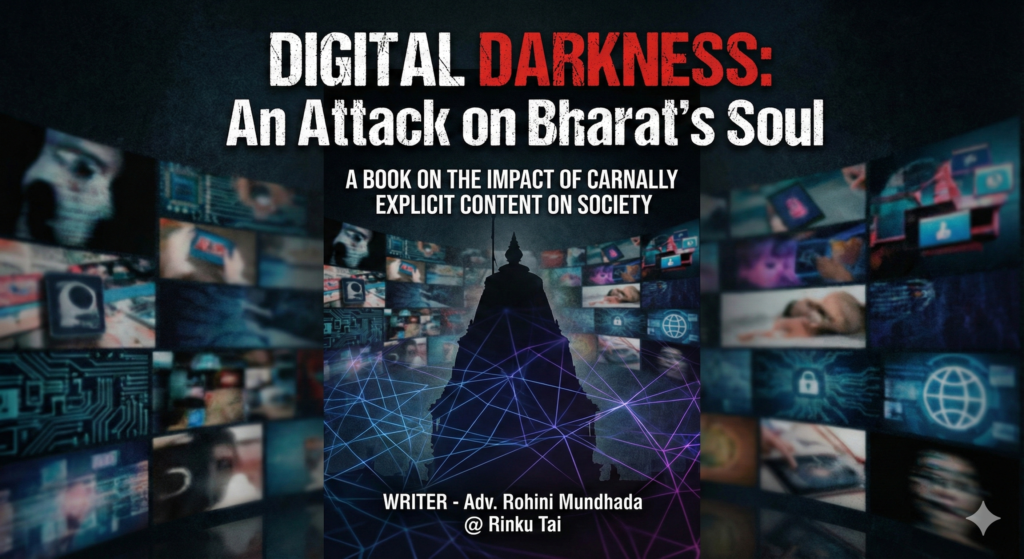
In the digital era, the line between freedom of expression and digital propaganda has become increasingly blurred, particularly in the context of carnally explicit content proliferating on social media platforms. In Bharat, where social media usage has surged to over 500 million active users, this content often masquerades as personal freedom but subtly propagates ideologies that erode traditional values and pollute the minds of young people.[1] As already mentioned explicit material, including obscene and intimate content, accounts for a significant portion of online traffic, with estimates suggesting 30-70% of Bharat’s internet activity involves such sites, exposing adolescents as young as 11-14 years old.
When such content and it’s creators are criticized they easily hide behind the veil of Freedom of speech and expression. But such content is associated with money making, specifically easy money making. In greed of easy money youth is forced to create such content in any way. This essay explores how to identify when such content crosses into propaganda versus protected expression under Bharat’s constitutional framework. Propaganda is defined as the systematic dissemination of ideas to influence public opinion.[2] By examining its impact on youth, legal boundaries, and the need for balanced regulation, we highlight the risks of unchecked exposure leading to psychological distress, distorted relationships, and societal decay.
Freedom of Expression in Bharat: Constitutional Foundations
Bharat’s Constitution enshrines freedom of speech and expression under Article 19(1)(a), a fundamental right that empowers citizens to voice opinions, share ideas, and engage in discourse without undue interference. However, this right is not absolute; Article 19(2) permits reasonable restrictions. These restrictions include Sovereignty and integrity of Bharat, Security of the State, friendly relations with foreign States, public order, decency or morality, contempt of court, defamation, incitement to an offence.[3]
In the digital realm, social media platforms serve as modern public squares, amplifying voices but also hosting content that tests these limits. For instance, sharing explicit material might be defended as artistic or personal expression, yet when it promotes objectification or harmful stereotypes, it veers toward violating societal norms. Some acts of human life are to be done in private, hence humans developed the science of civil engineering and architecture. Such kind of carnally explicit content includes am action to be performed behind the closed doors. As social media is modern public square, such kind of content on social media platforms is doing such private acts publically.
Courts have upheld that obscenity, defined under Section 292 of the Indian Penal Code (IPC) as material appealing to prurient interest, is not protected speech.[4] Now IPC is repealed in Bharat due to enactment of Bharatiya Nyaya Sanhita, 2023 (BNS). Section 294 and 295 prohibit sale and circulation of obscene material to adults and minors respectively. Thus Bharat is having basic statutory provision to stop spread of such content even in digital form.
Recent rulings, such as those emphasizing that merely liking obscene posts does not constitute transmission under Section 67 of the Information Technology (IT) Act.[5] But algorithm of social media works differently based on numbers. More the likes and comments on the post, higher will be its spread.[6] Hence it is necessary to count even a single activity on such posts while considering its impact on society. Nonetheless, the rapid spread of explicit content challenges this framework, often framing restrictions as censorship rather than safeguards for vulnerable groups like youth.
The Nature of Digital Propaganda: Beyond Mere Expression
Digital propaganda involves the deliberate spread of information to manipulate perceptions, often disguised as neutral content. Unlike straightforward freedom of expression, which fosters open dialogue, propaganda seeks to indoctrinate, exploiting algorithms to target impressionable audiences. In Bharat, explicit content on platforms like Instagram and X (formerly Twitter) can function as propaganda by normalizing Westernized views of sexuality, undermining cultural values of modesty and restraint rooted in Bharatiya heritage. For example, viral posts promoting “body positivity” through semi-nude imagery may propagate consumerist or hedonistic ideals, influencing youth to adopt behaviors conflicting with familial teachings.[7]
Identifying propaganda requires examining intent: Does the content inform or incite? Explicit material often employs subtle messaging, such as glorifying casual encounters, which can erode mental autonomy and propagate disinformation about relationships.[8] Discussions on various platforms highlight concerns, with users calling for penalties on creators posting obscene content to protect women’s dignity, underscoring how such material propagates harmful stereotypes under the guise of freedom.[9] Many exports suggest that platforms shall also held liable as publisher of such carnally explicit content. In western country USA, such policies are in force where creator and platform are held liable.[10]
Explicit Content as Propaganda: Polluting Young Minds
Carnally explicit content on social media acts as an insidious form of propaganda by desensitizing youth to moral boundaries, leading to distorted views of intimacy and self-worth. In Bharat, where 47% of adolescent boys and 6% of girls report exposure to obscene content, early access, often via smartphones, fuels addiction and psychological issues like anxiety, depression, and unrealistic expectations in relationships.[11]
Studies reveal that problematic obscene content use, starting around age 14, correlates with stress and compulsive behaviors, polluting minds by normalizing aggression and objectification. This propaganda subtly propagates patriarchal or exploitative narratives. Unlike protected expression, which might include educational discussions on carnal desirability, explicit content often lacks context, leading to associations with crime. In rural and urban Bharat alike, this exposure disrupts personality development, fostering a disease of today’s youth that impairs emotional health and societal cohesion.[12] There are lot of incidences recorded in Bharat, that a woman is harassed publically. Even in some assault cases it has been investigated that culprit watched such kind of content before committing brutal crime.[13]
Impact on Young People: Psychological and Societal Ramifications
The pollution of young minds through explicit content manifests in multifaceted ways, from individual distress to broader societal shifts. Adolescents exposed to pornography report higher rates of emotional problems, reduced sexual satisfaction, and increased aggression, as it warps perceptions of consent and relationships.[14] It must be noted that similar problems arose in adults also disturbing their family and causing emotional imbalance. There are cases where one spouse demanded divorce due to obscene content addiction of other spouse.[15] Although Court rejected such plea in the name of self-pleasure, but this is alarming situation as this addiction demanding beyond the reality.
In Bharat, with 1.5 billion monthly visits to porn sites and 64% of young men reporting addiction, this propaganda exacerbates mental health crises, linking to higher suicide risks and family breakdowns. Youth, comprising over 65% of Bharat’s population under 35, are particularly vulnerable, as early exposure, leads to compulsive viewing and distorted self-image. As per study 80% of boys and 70% of girls before 18 are exposed to such content. [16] Societally, it propagates a culture of instant gratification, clashing with values of dharma and restraint, potentially increasing sexual crimes under the Protection of Children from Sexual Offences (POCSO) Act and The Immoral Traffic (Prevention) Act, 1956 (ITPA).[17]
Legal Framework and Challenges in Regulation
Bharat’s legal arsenal includes the IT Act, BNS Sections 294-295, and POCSO Act, which criminalize obscene and child-exploitative content, empowering authorities to block sites and penalize distributors.[18] The Supreme Court has urged guidelines for abusive online content, balancing free speech with victim protection.[19] Challenges arise in distinguishing propaganda from expression: Algorithms amplify explicit material, evading filters, while over-regulation risks stifling dissent. The National Commission for Women (NCW) has called for OTT and social media accountability to curb content violating decency laws. Effective enforcement requires digital literacy and international cooperation, as global platforms host much of this propaganda.[20]
Balancing Act: Safeguarding Freedom While Curbing Propaganda
To navigate this dilemma, Bharat must prioritize education and self-regulation alongside laws. Promoting media ethics and AI-driven moderation can identify propaganda without blanket censorship. Encouraging parental controls and school programs on healthy sexuality can mitigate pollution of young minds, while courts refine tests for obscenity. Ultimately, distinguishing involves assessing harm: Expression enlightens; propaganda manipulates.[21]
Identifying digital propaganda versus freedom of expression in the realm of explicit content is crucial for protecting Bharat’s youth from mental pollution. As explicit material propagates harmful ideologies on social media, it threatens cultural integrity and psychological well-being. By strengthening legal frameworks, fostering awareness, and balancing rights, Bharat can preserve expression while shielding society from propaganda’s insidious grasp. Just blocking such users is the first step that one can take to prohibit spread of such content. Reporting it in appropriate category defining obscenity and nudity is next step that user can take when he/she comes across such content.
[1] Himani Adarsh and Swapnajeet Sahoo, “Pornography and Its Impact on Adolescent/Teenage Sexuality”, Sage Journals, available at: https://journals.sagepub.com/doi/full/10.1177/26318318231153984, Last visited on 19.12.2025
[2] “propaganda”, Britannica, available at: https://www.britannica.com/topic/propaganda, Last visited on 19.12.2025
[3] Article 19(2) of the Constitution of India, 1949.
[4] Aashia Jindal, Sanket Gupta, “Obscenity Or Absurdity: The Unclear Laws In India”, The Haryana Police Joural, Vol 3, 2020.
[5] Jayanti Pahwa, “Merely Liking A Provocative Post Will Not Attract Section 67 Of The IT Act: Allahabad High Court”, Verdictum, Dt. 26.10.2023, available at: https://www.verdictum.in/court-updates/high-courts/merely-liking-a-provocative-post-will-not-attract-section-67-of-the-it-act-allahabad-high-court-1501314, Last visited on 19.12.2025
[6] Soumyanarayan L, “Like, Comment, and Share: The Power Behind Social Media Engagement”, LinkedIn, Dt. 16.9.2024, available at: https://www.linkedin.com/pulse/like-comment-share-power-behind-social-media-engagement-l-iwmvc/, Last visited on 19.12.2025
[7] Padmakshee Sharma, “Mental Autonomy and the Internet: A Reflection on Digital Propaganda in India”, Oxford Political Review, Dt. 20.5.2022, available at: https://oxfordpoliticalreview.com/2022/05/20/mental-autonomy-and-the-internet-a-reflection-on-digital-propaganda-in-india/, Last visited on 19.12.2025
[8] “Obscene, Indecent and Profane Broadcasts”, Federal Communications Commissions, available at: https://www.fcc.gov/consumers/guides/obscene-indecent-and-profane-broadcasts, Last visited on 19.12.2025
[9] “What penalties do individuals and platforms face for violating China’s online content rules?”, factually, Dt. 4.12.2025, available at: https://factually.co/fact-checks/law/penalties-for-violating-china-online-content-rules-407646, Last visited on 19.12.2025
[10] Jimmy Fraley, “Social Media Platforms as Publisher: Evaluating the First Amendment Basis for Content Moderation”, The Princeton Legal Journal, available at: https://legaljournal.princeton.edu/social-media-platforms-as-publishers-evaluating-the-first-amendment-basis-for-content-moderation/, Last visited on 19.12.2025
[11] Shobhit Shrivastava, “Exposure to pornographic content among Indian adolescents and young adults and its associated risks: Evidence from UDAYA survey in Bihar and Uttar Pradesh” Population Council, Dt. 1.1.2023, available at: https://knowledgecommons.popcouncil.org/focus_adolescents/80/, Last visited on 19.12.2025
[12] Suresh Bada Math, “Sexual Crime in India: Is it Influenced by Pornography?”, National Library of Medicine, available at: https://pmc.ncbi.nlm.nih.gov/articles/PMC4031582/, Last visited on 19.12.2025
[13] Rajesh Saha, “Kolkata doctor’s rapist had liquor before crime, used to watch porn: Sources”, India Times, Dt. 12.8.2024, available at: https://www.indiatoday.in/india/story/kolkata-doctor-rape-murder-case-accused-sanjay-roy-liquor-watched-porn-bengal-police-2580653-2024-08-11, Last visited on 19.12.2025
[14] Anna Butjosa, “Impact of pornography consumption on children and adolescents: a trauma-informed approach”, Frontiers, Dt. 29.09.2025, available at: https://www.frontiersin.org/journals/child-and-adolescent-psychiatry/articles/10.3389/frcha.2025.1567649/full, Last visited on 19.12.2025
[15] Salil Tiwari, “‘Wife’s Watching Porn, Self-Pleasure Not Cruelty’: Madras HC Rejects Husband’s Divorce Plea”, News18, Dt. 20.3.2025, available at: https://www.news18.com/india/wifes-watching-porn-self-pleasure-not-cruelty-madras-hc-rejects-husbands-divorce-plea-9268056.html, Last visited on 19.12.2025
[16] Himani Adarsh, “Pornography and Its Impact on Adolescent/Teenage Sexuality”, Sage Journals, available at: https://journals.sagepub.com/doi/full/10.1177/26318318231153984, Last visited on 19.12.2025
[17] Chavan, Rajendra L, “Pornography: An Alarming Psycho-Social Effects among Post Graduate Students”, Eric, available at: https://eric.ed.gov/?id=ED619541, Last visited on 19.12.2025
[18] “Social Media And Censorship In India”, Indian Law News, Dt. 1.9.2012, available at: https://indialawnews.org/2012/09/01/social-media-and-censorship-in-india-2/, Last visited on 19.12.2025
[19] Krishnadas Rajagopal, “Supreme Court asks government to regulate abusive online content”, The Hindu, Dt. 27.11.2025, available at: https://www.thehindu.com/news/national/supreme-court-asks-government-to-regulate-abusive-online-content/article70331564.ece, Last visited on 19.12.2025
[20] Rishabh Pahawa “Review Of Legislations On Online Content Regulation In The World”, IMEITY/2018/03505
[21] Shweta Singhal, “Analysis of Freedom of Speech and Expressions on Digital Media Platforms to Cyber Laws in India”, The Academic
Send an email by clicking the red button below! As you click the button an automatic mail will be ready for you to send. This email is addressing to Chief Ministers of all states of Bharat and Prime Minister of Bharat.
As you have sent the Email, share this article with others. Greater the social issue, more awareness is required!

Want to curb social media addiction, start reading!
Very good information