
Case Details
Title of the Case: Niyaz Ahmad Khan vs State Of U.P. And Another
Court: Allahabad High Court
Case number: AFR. (Allahabad Full Report/Reserved) and Application U/S 482 No. – 28742 of 2021.
Bench/Coram of the Case and Author of the Judgment: Hon’ble Sanjay Kumar Singh, J.
Names of Parties
Applicant: Niyaz Ahmad Khan
Respondent: State of U.P. and Another Awadesh Pandey, Senior Sub Inspector, Opposite Party No. 2)
Type of Matter in Question: Criminal. It is an application filed under Section 482 of the Code of Criminal Procedure, 1973, (CrPC) seeking to quash a charge-sheet, a cognizance/summoning order, and the subsequent criminal proceedings. Equivalent to Section 528 of BNSS i.e. saving of inherent powers of High Court
Legal Provisions Discussed
The case primarily discusses criminal offenses and procedural law:
- Indian Penal Code, 1860 (IPC): Section 500 (Punishment for defamation): BNS Section 356
- CrPC: Section 482 (Saving of inherent power of High Court): Section 528 of BNSS
- Information Technology (Amendment) Act, 2008 (ITA Act): Section 67 (Publishing or transmitting obscene material in electronic form)
The judgment refers to and relies upon several precedents, primarily cited by the learned Additional Advocate General for the State of U.P.:
- Nikhil Racheti Vs. State of Maharastra, (2006) SCC Online Bom. 1650.
- Manoj Oswal v. State of Maharashtra, (2013) SCC OnLine Bom 978.
- Life Insurance Corporation of India v. Manubhai D. Shah, (1992) 3 SCC 637.
- Ekta Kapoor v. State of M.P., (2020) SCC OnLine MP 4581.
- Sharat Babu Digumarti v. Government of Delhi (NCT), (2017) 2 SCC 18.
- Chambers Vs. Director of Public Prosecutions, [(2013) 1 WLR 1833] (Queen’s Bench Division).
Nature of the Crime
The case involves a crime related to obscene material in the context of the IT Act. Specifically, the applicant was charged under:
- Section 67 of the ITA Act, 2008: This section deals with publishing or transmitting any material that is lascivious or appeals to the prurient interest in electronic form which the court discussed in relation to the morphed photos.
- Section 500 of the IPC: For defamation, based on sharing morphed photographs of the Prime Minister and a Cabinet Minister.
The court extensively discussed the ingredient of “lascivious or appeals to the prurient interest” as it relates to the shared morphed photos, citing precedents that define these terms under the IT Act and Section 292 of the IPC (Obscenity), equivalent to Section 294 of BNS.
Details of FIR
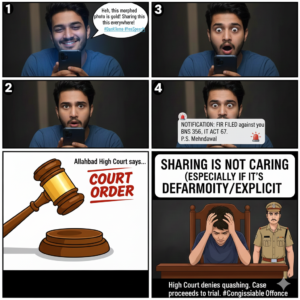
The criminal case originated from a First Information Report (FIR) that was lodged by the Opposite Party No. 2, Awadesh Pandey, a Senior Sub Inspector, on November 28, 2019, at Police Station Mehndawal, District Sant Kabir Nagar. The case was registered as Case Crime No. 296 of 2019. The applicant, Niyaz Ahmad Khan, was booked under Section 67 of the ITA Act, 2008, and Section 500 of the IPC. The core allegation in the FIR was that the applicant had shared objectionable and morphed photos on Facebook. These included a photo purporting to show the Hon’ble Prime Minister, Narendra Modi, shaking hands with a terrorist, and a second morphed image depicting the Prime Minister and a Cabinet Minister feeding biscuits to dogs marked with names of TV channels, along with a defamatory accompanying remark about the media.
Proceedings of Trial Court
Following the registration of the FIR, the Investigating Officer conducted the necessary investigation. Upon concluding the probe, the Investigating Officer submitted a formal charge-sheet against the applicant on January 27, 2020. This charge-sheet concluded that sufficient material existed to establish a prima facie case against the applicant for the commission of the alleged offenses. The matter was subsequently listed before the trial court as Criminal Case No. 2887 of 2020, titled State Vs. Niyaz Ahmad Khan.
Order of Trial Court
Based on the charge-sheet and the material presented, the learned Additional Chief Judicial Magistrate, Sant Kabir Nagar, proceeded to take cognizance of the offenses on July 22, 2020. Concurrently with the cognizance, the Magistrate issued a summoning order, formally directing the applicant to appear before the court and face trial under Section 67 of the IT Act and Section 500 of the IPC.
Details of Appeal before HC
The applicant initiated the proceedings before the High Court by filing an Application under Section 482 of the CrPC. This application invoked the inherent jurisdiction of the High Court with the specific objective of quashing the charge-sheet dated January 27, 2020, the cognizance/summoning order dated July 22, 2020, and the entirety of the pending criminal proceedings. After a thorough examination of the facts, the allegations, and the relevant legal precedents governing the inherent power of the court, the Allahabad High Court ultimately declined to grant the relief sought by the applicant, thereby dismissing the application and allowing the criminal case to proceed to trial.
Arguments of the Parties
The Applicant argued that the criminal proceedings against him should be quashed because the investigation was incomplete and faulty. His primary defense was that he only shared the objectionable posts, and the charge-sheet was submitted without tracing the original creator of the morphed photo i.e. the “unknown person” due to the unavailability of the Uniform Resource Locator (URL). He essentially claimed he was falsely implicated and that the case against him was not made out.
The Respondent vehemently opposed the quashing application. Their argument centered on the fact that the Applicant, a Headmaster holding a respected public position, deliberately shared highly objectionable and insulting content concerning individuals in esteemed positions, such as the Prime Minister and a Cabinet Minister. They contended that the act of sharing itself was an offense under both Section 67 of the IT Act and Section 500 of IPC, as it was a deliberate act to publish defamatory and lascivious/prurient material. They asserted that the FIR and the materials presented disclosed a cognizable offense, and the proceedings were not an abuse of the court’s process.
Arguments Accepted by the Court and Reasons
The High Court accepted the arguments of the Respondent parties and ultimately dismissed the Applicant’s request to quash the criminal proceedings. The Court found that based on the FIR and the charge-sheet material, a cognizable offense was prima facie disclosed against the Applicant. The Court emphasized that its power under Section 482 CrPC should be used sparingly, and at this pre-trial stage, it only needed to be satisfied that a ground existed to proceed to trial. The Court implicitly accepted the argument that the Applicant’s act of sharing the morphed photographs constituted publication and transmission of objectionable content, thereby attracting the ingredients of Section 67 of the IT Act i.e. publishing or transmitting lascivious material in electronic form and Section 500 IPC i.e. defamation.
The Court took a strong view on the misuse of social media platforms, noting that using cyberspace to vent frustration by travestying key figures is abhorrent and violates the right to reputation. The act of posting and sharing unhealthy content, regardless of whether the Applicant was the original creator, was deemed hazardous to a civilized society. The Court held that the Applicant’s defense regarding the lack of proper investigation and the difficulty in tracing the original source were disputed questions of fact that must be resolved by the trial court during the proceedings, not by the High Court in a quashing application.
Precedent Analysis:
The court undertook a detailed analysis of various legal precedents to determine the scope of its inherent power under Section 482 of the CrPC and to clarify the legal interpretation of the offenses involved, particularly under the IT Act. The primary focus of the precedent analysis was threefold: first, establishing the stringent criteria for quashing a criminal proceeding at the pre-trial stage; second, defining the necessary ingredients of the offenses under Section 67 of the IT Act i.e. publishing obscene/lascivious material and Section 500 IPC i.e. defamation in the context of electronic media; and third, addressing the issue of whether a criminal complaint is barred when civil remedies are available. The court relied on rulings from the Supreme Court and other High Courts to reinforce the principle that its power to quash proceedings should be used sparingly and only in exceptional cases where the allegations, taken at face value, fail entirely to disclose a cognizable offense.
Nikhil Racheti vs. State of Maharastra [(2006) SCC Online Bom. 1650], laid down the three essential elements of Section 67 of the IT Act: publication or transmission in electronic form, the material being lascivious or appealing to prurient interest, and the material tending to deprave and corrupt persons likely to see it. This analysis was crucial in confirming that the Applicant’s act of sharing the morphed photos could potentially satisfy these criteria, even though he was not the original creator.
By referring to Ekta Kapoor v. State of M.P. [(2020) SCC OnLine MP 4581], the court acknowledged that the IT Act, as a special legislation dealing with obscenity in electronic form, has an overriding effect over general provisions like Section 292 IPC. This legal understanding was used to justify the continuation of the charges under the specific statute.
Citing Manoj Oswal v. State of Maharashtra [(2013) SCC OnLine Bom 978], the court affirmed that the freedom of speech and expression is not absolute but is subject to reasonable restrictions, especially when it is indecent, contemptuous, or defamatory, emphasizing that no one can use their freedom of speech to injure another’s reputation.
The court also cited the Queen’s Bench Division case, Chambers Vs. Director of Public Prosecutions [(2013) 1 WLR 1833], regarding the impact of social media handles, underscoring the serious societal reverberations of misuse of online platforms. This comprehensive review of judicial precedent allowed the court to conclude that the continuation of the trial was necessary and that the Applicant’s claims, being essentially disputed facts, could not form the basis for quashing the validly instituted criminal process.
Purpose and Limitation of Section 482
The court emphasized that the inherent power vested in the High Court under Section 482 CrPC is an extraordinary jurisdiction that should be exercised sparingly, cautiously, and with circumspection. This power is not meant to be used in a routine manner to prematurely terminate criminal trials. The fundamental purpose of Section 482 is threefold: to give effect to any order under the CrPC, to prevent abuse of the process of any court, and otherwise to secure the ends of justice.
Grounds for Refusal to Quash
The High Court refused to quash the proceedings based on the established legal principle that its inherent power should only be invoked in rare and appropriate cases where the allegations in the FIR or the charge-sheet, when taken at their face value and accepted entirely, do not disclose the commission of any offense against the accused. The court found that, considering the nature of the allegations such a sharing morphed and defamatory images of high-ranking public officials, a cognizable offense was clearly made out under both the IPC and the IT Act. Since the materials sufficiently indicated a basis for the charges, the court could not intervene.
The Applicant’s argument that the investigation was improper, or that he was merely a sharer and not the creator of the content, constituted a disputed question of fact and a defense plea. The court categorically held that such disputed factual issues cannot be taken into consideration at the pre-trial stage under Section 482 CrPC. The resolution of these facts, and the determination of guilt or innocence, is the exclusive function of the trial court where evidence can be properly led and examined. The court concluded that since the FIR and the charge-sheet disclosed a prima facie offense, the criminal proceedings could not be termed an abuse of the process of the court. The High Court was therefore not justified in assuming jurisdiction under Section 482 CrPC to terminate the trial process initiated by law. In essence, the High Court saw its role not as a second trial court to weigh the evidence, but as a judicial gatekeeper, finding that the threshold for exercising its quashing power had not been met because the charges were supported by prima facie material.
Order of AHC
The High Court ultimately refused the relief sought by the Applicant. The court found no illegality or material irregularity in the cognizance/summoning order dated July 22, 2020, which had been passed by the Additional Chief Judicial Magistrate. Consequently, the court saw no reason to intervene by invoking its inherent powers under Section 482 of the CrPC. The operative part of the judgment therefore contained the following directives:
1. Dismissal of Application: The application filed by the applicant under Section 482 CrPC was dismissed.
2. Continuation of Proceedings: The court’s refusal meant that the criminal proceedings, including the charge-sheet and the summoning order, were upheld. The trial court was permitted and expected to continue with the trial in Criminal Case No. 2887 of 2020 against the applicant for the alleged offenses under Section 67 of the IT Act and Section 500 of the IPC.
3. No Stay or Quashing: There was no quashing of the FIR, the charge-sheet, or the summoning order, and no stay was granted on the criminal proceedings pending before the Magistrate.
In simple terms, the High Court’s order allowed the criminal case to move forward, directing the applicant to face the trial court proceedings.
Conclusion:
Thus sharing of defamatory content, explicit content can be crime and person sharing such content is also guilty under IT Act, although he/she is not creator. So be careful while sharing memes or any other type of content about any famous figure on social media.
Pingback: CAD: Pledge to Proclaim Independence of India: Part 5 – bharatlex-rinkutai.com
Pingback: Cognitive Dissonance in the Digital Age: How Bharat Consumes Data – bharatlex-rinkutai.com