2.3.3 Section 2:
Bare Act Provisions:
2. Definitions.—In this Act, unless the context otherwise requires,—
(a) “commencement of this Act” means the commencement of this Act on the 11th day of July, 1991;
(b) “conversion”, with its grammatical variations, includes alteration or change of whatever nature;
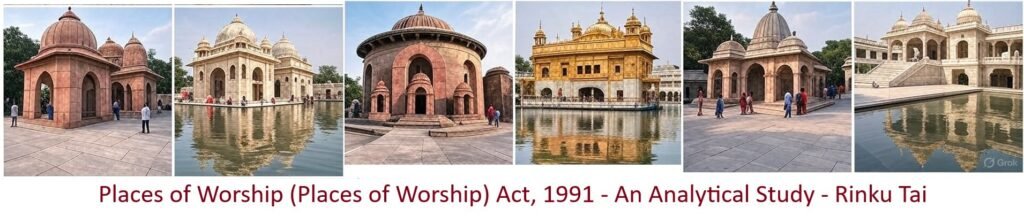
(c) “place of worship” means a temple, mosque, gurudwara, church, monastery or any other place of public religious worship of any religious denomination or any section thereof, by whatever name called.
Interpretation and Explanation:
Definitions given in any statute are light house to interpret the provisions mentioned in it and find out the applicability of the provisions.
Clause (a): “Place of worship” means a temple, mosque, gurudwara, church, monastery or any other place of public religious worship of any religious denomination or any section thereof, by whatever name called.
This definition is broad and inclusive, covering various types of religious structures or locations where communal worship occurs. It aims to encompass all forms of places where religious activities are conducted, ensuring that the Act’s provisions apply universally to all religious sites in India. The inclusivity of “place of worship” to cover all religious denominations for maintaining communal harmony.[1]
While discussing the significance of places of worship in the context of religious rights under Article 25, in Ismail Faruqui v. Union of India, the Court observed the sanctity of religious places lend weight to the comprehensive definition provided by the Act.[2] The term “place of worship” has been implicitly interpreted in various cases where religious rights are in question, like in Church of God case, where the court dealt with the rights concerning the use of a place for worship, reinforcing that any structure or location used for religious congregation falls under this definition.[3] The clause ensures no religious site is left out, whether it’s a traditional structure like a temple or a less conventional place where people gather for worship.
Clause (b): “Religious character” of a place of worship means its religious identity, character and denomination as it existed on the 15th day of August, 1947. This term defines the religious essence or identity of a place of worship based on how it was on the date of Bharat’s independence.
This definition is crucial because it sets a historical benchmark for determining the religious nature of any place of worship, preventing changes or disputes over conversion post-independence, without giving right to be heard to the parties who want to claim their historical religious places, which were destroyed and converted on the ruins of previous structure. The definition is putting a bar to correct the historical wrong and preserve the culture of the land. Various cases where the religious character of places has been in dispute implicitly uphold this definition. For instance, in Pannalal Bansilal Patil v. State of Andhra Pradesh, the court dealt with issues related to the religious use of properties, implicitly recognizing the importance of maintaining the historical religious character of places.[4]
The clause uses August 15, 1947, as the reference date to determine what the “religious character” of a place of worship is, arbitrary in nature and does justify the historical wrongs done by the foreign rulers and invaders. The definition serves the Act’s broader goal of ensuring that no religion or denomination can claim a change in the status of a place of worship post-independence.
Clause (c): “Conversion”, with its grammatical variations and cognate expressions, means the conversion of a place of worship of one religious denomination or any section thereof into a place of worship of a different religious denomination or any section thereof. This term specifies the act of altering the religious identity or use of a place of worship from one religion to another or from one sect to another within the same religion. It’s pivotal because the Act’s primary purpose is to prevent such conversions post-1947, aiming to maintain the status quo of religious structures. The definition aims to stop any act of converting one religious place into another, recognizing the potential for such actions to lead to communal discord.
References:
[1] Ayoadhya Verdict
[2] Ismail Faruqui v. Union of India [[1994] Supp. (5) S.C.R. 1]
[3] Church of God (Full Gospel) in India v. K.K.R. Majestic Colony Welfare Association [2000 AIR SCW 3089]
[4] Pannalal Bansilal Patil v. State of Andhra Pradesh [1996 SCC (2) 498]
Add this website to your bookmarks to know more about these laws in simple language so that you can understand the provisions, their purpose, impact of implementation, failure to protect culture and much more. Share if you found it important for battle of cultural preservation